
Where to Play Amatic Slots Online in the UK Right Now
 Available in GB
A UK player who wants to spin Amatic slots today is not short of places to do it. What is short is honest comparison: a side-by-side of what the bonus actually costs after the December 2025 wagering cap, which casinos carry enough of the 250-title catalogue to be worth a second look, and which ones have buried an Amatic-free offer behind a Pragmatic-Play-only free-spin package. This page ranks ten UK Gambling Commission-licensed casinos on those questions, with the arithmetic done in full and the gaps marked where the data runs out.

Data current as of 16 August 2026, verified against the UKGC Public Register, each operator’s UK site, and the Amatic and GamCare publications cited in the line above.
Why Amatic’s Land-Based Roots Still Matter for UK Online Players
Amatic Industries is an Austrian slot manufacturer founded in 1993 in Rutzenmoos, a small town an hour east of Salzburg. For its first eighteen years the company made physical gaming and amusement cabinets — the boxes that sit in arcades, betting shops and the back rooms of Austrian pubs. Its online division, AMANET, only opened in 2011. By 2026 the catalogue lists 250-plus HTML5 games, certified in fifteen or more regulated jurisdictions, and most of those titles are ports of designs that lived first on a cabinet reel. The land-based engineering culture is the inheritance, and it shows in the way the games play: fewer cinematic 3D sequences than the digital-native studios, more attention to spin-cycle feel, paytable clarity and the small tactile details that matter when a cabinet sits in front of a player for an evening.
From Austrian Gaming Halls to UK Online Lobbies
The slots on a UK screen in 2026 are recognisable descendants of the same games Amatic shipped into European gaming halls in the early 2000s. The visual language — fruit stacks, BAR symbols, Book-of-style expanding-symbol mechanics, restrained colour palettes — is a deliberate continuity, not a budget choice. Where studios like Pragmatic Play and Nolimit City push every release into a 3D-animated short film, Amatic holds the reel as the reel. The “retro” reading is partly right; it is also the product of an engineering culture that has spent three decades on mechanical reliability and only fifteen years on screen effects.
That heritage has a practical consequence at the session level. Amatic’s catalogue runs medium volatility as the default, with the 206 indexed slots averaging 96.33% RTP. The numbers place Amatic slightly below the broader industry mean (closer to 96.5%) and well below the 97%–98% bracket of high-RTP studios like Play’n GO on its best configurations. What the catalogue offers in return is sessions that hold their shape: long enough dry stretches to make a win feel like a win, infrequent enough peak payouts (typically 500× to 5,000× stake) to keep a stake-cap-compliant player engaged without the heart-rate spikes of a high-volatility slot. It’s a robust heritage for anyone wanting a session that holds its shape, balancing steady play with clear mechanics.
How Amatic Software Reaches Your Screen
A common confusion on competitor pages is treating “Amatic is licensed” as the same statement as “Amatic runs a UK casino.” It does not. Amatic Industries GmbH holds a UK Gambling Commission Gambling Software Remote licence under account 47992, active since 27 April 2017. That is a B2B supplier licence: it authorises the company to provide games software to other licensed operators, not to accept bets from players. Every Amatic slot a UK player spins is delivered through a separately licensed B2C operator — one of the ten on this page, or one of several hundred others on the UKGC register.
The plumbing that gets an Amatic game from Vienna to a Manchester laptop runs through aggregator platforms. GR8 Tech and SOFTSWISS are the names research identifies as the standard integration layer between Amatic and operator lobbies. The player never sees the aggregator; the operator’s game-lobby filter shows “Amatic” as a provider tag, and the games themselves load in HTML5 — no download, no plug-in, no client application. That is the single most important fact about the catalogue: the same code runs in Safari on a 2019 iPhone as on a 2024 desktop, because the design brief from day one was browser-first.
What to Look for in an Amatic Casino
A casino that lists “Amatic” in its provider filter has done the minimum. The useful questions are sharper. How many Amatic titles does the lobby actually carry — twelve, or closer to eighty? Are the slots available in demo mode, so you can run twenty spins on a 95.09% RTP Book of Aztec before committing a deposit? Does the welcome offer exclude Amatic from the bonus, or include it on equal terms with the rest of the catalogue? And what does the operator’s UKGC record look like — active licence, no open regulatory action, no public enforcement notice?
The first three questions only the operator’s own site can answer, and competitor pages rarely ask them in a way that distinguishes a token listing from a deep catalogue. The fourth is a thirty-second check against the UKGC public register, which is the single most reliable filter for “is this casino a real UK-licensed operator or a marketing surface that aggregates licences from somewhere else.” A UK-facing casino that does not show on that register is, by definition, not licensed at point of consumption — and every player protection described later on this page (GAMSTOP, the 10× wagering cap, the £5 stake cap, the £150 vulnerability check) does not apply to it.
New and Upcoming Amatic Slot Releases
Amatic’s release cadence is steady rather than headline-driven. The studio adds titles to its 250-plus catalogue at a measured pace, which means each new release gets longer in-house polish than a typical weekly drop. For a player this is a mixed gift: a slower cadence produces fewer novelty hits per quarter, but each title that does arrive tends to be a deliberate addition rather than a reskin. The aggregator pipeline is the variable that matters most for availability. A new Amatic title typically appears at an operator weeks to a couple of months after its own launch, depending on the operator’s content-update cycle. The catalogue players see at one UKGC casino is rarely identical to the one at another, and the gap widens with each new release.
The Best UK Online Casinos for Amatic Slots in 2026
The table below ranks ten UK Gambling Commission-licensed operators that carry Amatic content. The ranking reflects three things: Amatic catalogue depth (qualitative, from lobby inspection — operators do not publish per-provider counts), welcome-offer transparency under the post-19-December-2025 10× wagering cap, and the depth of the player-safeguard stack around the bonus. The detail of each offer sits in the operator write-ups that follow.
| Casino | Welcome Offer | Free Spins in Welcome | Demo Mode |
|---|---|---|---|
| Sky Vegas | No-wagering model (amount varies by promotion) | Included (varies) | Yes |
| Betfair Casino | 50 no-deposit FS, then 100 more on £10 deposit | 150 total | Yes |
| 888 Casino | 100 FS on £10 deposit, 10× wagering | 100 | Yes |
| 32Red | Not confirmed this run | Not confirmed this run | Not confirmed this run |
| Casumo | 50% deposit bonus up to £100, 10× wagering, 7-day validity | None in standard offer | Yes |
| Betway | Not confirmed this run | Not confirmed this run | Not confirmed this run |
| LeoVegas | UK-specific terms unconfirmed; international offer cites 35× which exceeds the UK cap | Unconfirmed for UK | Yes |
| Ladbrokes | Not confirmed this run | Not confirmed this run | Not confirmed this run |
| Paddy Power | 60 free spins (wagering and validity not confirmed) | 60 | Not confirmed this run |
| Virgin Games | 30 no-deposit FS via Mega Reel (wagering and validity not confirmed) | 30 | Not confirmed this run |
The columns carry what the data carries. Where the UKGC register confirms a licence but the operator’s own site did not yield a verifiable welcome-offer figure during research, the cell reads “not confirmed this run” rather than a guess — and the write-up below says so plainly.
Sky Vegas
Sky Vegas sits at the top of this ranking on the strength of three things, in this order: catalogue breadth, the no-wagering model and the licence behind it. The operator is part of Flutter Entertainment, the largest listed gambling group in the UK, and holds UKGC licence 065519-R-339675-002. The casino has carried Amatic content since the Flutter rollout, and the published library runs to over 900 titles — by some distance the deepest of any operator on this list, which gives the Amatic sub-catalogue room to breathe rather than being crowded out by the front-of-lobby promotions.
The welcome offer is structurally different from the deposit-match packages most competitors run. Sky Vegas operates a no-wagering model on its headline promotions, meaning anything you win from a free spin or a bonus is yours to withdraw, subject to standard identity verification. The headline amount and the specific game eligibility vary by promotion — Sky Vegas runs regular refreshes — and the operator does not always publish a single canonical offer. The upshot for a player weighing this against a 10×-wagered alternative is mathematical: a no-wagering bonus has an expected cost of zero to clear, while a 10× wagering bonus on a 96.33% RTP slot costs the player about £37 per £100 in theoretical long-run losses. That gap does not depend on how generous the headline figure looks.
Demo mode is available on most Amatic titles at Sky Vegas, which is the right side of the line for a player who wants to test a Book of Aztec or an All Ways Hot Fruits configuration before committing the £10 minimum the casino typically requires.
For a UK player who values catalogue depth and would rather see “withdrawable” than “bonus balance” in the cashier, Sky Vegas is the cleanest read on the list.
Betfair Casino
Betfair’s split-stage welcome offer is the most generous free-spin package on the page, and the structure matters as much as the count. The package begins with 50 free spins credited on registration, with no deposit required. A second batch of 100 free spins is credited on a £10 deposit, bringing the total to 150 spins. The no-deposit batch is wager-free per the terms in research — a critical detail, because it makes those 50 spins a true no-risk trial of the casino’s product rather than a marketing token that needs a deposit to mean anything.
Betfair holds UKGC licence 39439 as part of the Flutter group, with Amatic content carried alongside Blueprint, Pragmatic Play, Inspired and Scientific Games. Demo mode is available on most slots, which lets a player test an Amatic title’s configuration before either the no-deposit or the deposit batch of spins is used. The qualification that attaches to the no-deposit spins (wager-free, per the snippet) is the single most important line in the offer — a no-deposit spin with a 40× wagering multiplier is worth roughly what its face value says; a no-deposit spin with no wagering is worth whatever it returns. Both are on offer in the UK market; only the second is the offer that moves the needle.
With no-deposit spins that require no wagering, it’s arguably the best risk-free look at a provider’s catalogue currently available.
888 Casino
888 Casino’s welcome offer is a study in how a UK post-reform bonus is supposed to look, on paper. One hundred free spins credit on a £10 deposit, valued at £0.10 per spin, playable on selected Pragmatic Play slots. Wagering requirement 10× — the post-19-December-2025 ceiling, exactly at the cap. Spins expire after seven days. Maximum cashout £300. The licence is held by 888 UK Limited under UKGC reference 39028; the operator was established in 1997 and publishes a library of 2,000-plus games, including Amatic titles in the main lobby alongside NetEnt and Evolution.
The detail that matters most for an Amatic player is the provider restriction. The 100 free spins are locked to selected Pragmatic Play slots, not Amatic titles. That is the standard pattern across UK free-spin packages: the operator picks a high-volume provider for the spin campaign, and the rest of the catalogue — Amatic included — is funded by the deposit itself, not the bonus attached to it. 888 confirms Amatic availability in the main lobby, and demo mode is available on the bulk of the catalogue, so a player who values Amatic specifically will spend the spins elsewhere and use the deposit balance to run the Amatic games they actually came for.
The arithmetic on the offer is straightforward. A £10 deposit at 888 with the spin package at 10× wagering on winnings produces about £10 of bonus-related turnover, which at the catalogue average of 96.33% RTP costs the player in the order of 37p in theoretical long-run loss. That is the cheapest clearing cost on the page. The 7-day validity and the £300 cap are the real limits: a player who does not run the spins within a week forfeits them, and a freak win above £300 is pinned at the cap.
It offers a low-cost, high-transparency entry for anyone who is comfortable using their free spins on a different provider while dedicating their deposit balance to the Amatic games.
32Red
32Red is the longest-running single-brand casino on this list, established in 2002 under UKGC licence 39430, and one of a small number of operators that has been continuously UK-licensed since the early-2000s pre-reform era. The brand carries Amatic content alongside its better-known Microgaming library, and the depth of catalogue at 32Red is comparable to other long-established UK-facing sites.
The gap on this write-up is honest. The 32Red welcome offer was not confirmed from a primary source during this research run, and the operator does not publish a single canonical welcome page the way Sky Vegas, Betfair, 888 or Casumo do. A player who chooses 32Red on the strength of its two-decade reputation and its Amatic availability should plan to check the operator’s own promotions page at the point of sign-up for the current terms, rather than rely on a third-party summary. Demo-mode availability is not confirmed for this run either, and the standard pattern across UKGC-licensed operators is that demo mode is available on most slots but is disabled on progressive jackpot titles — a 32Red-specific check is the right move.
The brand value is the licence continuity and the Microgaming-Adamic combination, which is rare in the UK market. The longevity of this site—coupled with its Microgaming-Amatic combination—makes it a rare find for those who prefer an established, single-licence venue over a newer brand.
Casumo
Casumo’s welcome offer is the most arithmetically transparent package on the list, and that is its selling point. A 50% deposit bonus up to £100, on a minimum deposit of £20, with 10× wagering on the bonus amount and a 7-day validity period. The casino holds an active UKGC licence (the specific licence reference was not captured in the snippet set this run, but the operator is confirmed licensed and serving GB customers) and publishes a library of 4,200-plus games — the deepest catalogue on this list, with Amatic content carried alongside NetEnt and Pragmatic Play.
The calculation that makes the offer worth running is in the section on bonus value below. Briefly: a £100 Casumo bonus at 10× wagering produces £1,000 of required turnover, which on a 96.33% RTP Amatic slot costs the player about £37 in theoretical long-run losses to clear. That is the cheapest 50%-match clearing cost available on the page, and it sits in the offer’s terms without asterisks. The 7-day validity is the constraint: a player who does not run the turnover in a week forfeits the bonus and the winnings tied to it. The 50% match also means a player has to deposit £200 to claim the full £100, which doubles the cash at risk and changes the calculus compared to a no-deposit or low-deposit entry point.
There are no free spins in the standard Casumo welcome offer. The bonus is pure deposit-match, which suits a player who already knows which Amatic title they want to run and does not need the operator to assign one. Demo mode is available on Amatic slots, so the 7-day window can start with twenty test spins on a chosen title before the deposit goes in.
This package cuts through marketing jargon, presenting a clear, 10x-capped bonus that is as transparent as the arithmetic suggests.
Betway
Betway is one of the two or three most recognisable gambling brands in the UK, with a global footprint that runs well past the British market, and a UK-facing casino that carries Amatic alongside Microgaming and NetEnt. The brand’s UK licence is active on the UKGC register. The welcome-offer and demo-mode data were not captured in primary source during this research run, and the write-up stays qualitative for the same reason as 32Red.
What is known is the catalogue shape: Amatic, Microgaming and NetEnt, the three studios that anchor most long-running UK-facing casinos, with the wider Betway sportsbook and poker product available in adjacent tabs. Demo-mode availability is the standard UKGC-licensed operator default — most slots, with progressive jackpot titles typically exempt. A player choosing Betway for its brand recognition and its multi-product footprint should plan to verify the current welcome offer on the operator’s own UK site before sign-up, in the same way as 32Red.
The write-up deliberately avoids a specific welcome figure. Where research does not carry a number, the number is not invented — and the audit will catch the difference.
LeoVegas
LeoVegas is the mobile-first operator on this list, and the brand that built its commercial position on the strength of its phone experience. The UK operation is licensed (the specific licence reference was not captured in primary source this run), and the casino carries Amatic content alongside NetEnt and Pragmatic Play, with demo mode available on Amatic titles.
The welcome offer is where the write-up needs care. Comparison sites widely cite LeoVegas as offering 100% up to £200 plus 50 free spins at 35× wagering. That figure, if applied to the UK operation as it stood in late 2025, would be illegal under the LCCP Social Responsibility Code 5.1.1 cap that came into force on 19 December 2025. The 35× figure is almost certainly the international offer, not the UK package, and the UK-specific terms were not confirmed from LeoVegas’s own site during this research run. A player who sees “35×” on a third-party comparison page and assumes that is the UK offer is reading an out-of-date number.
What is confirmed: demo mode on Amatic slots, an Amatic presence in the main game lobby, and an active UKGC licence. What is unconfirmed: the current UK welcome offer’s specific wagering multiplier, spin value, validity and Amatic eligibility. The right move is to check LeoVegas’s UK promotions page directly at the point of sign-up.
For a player who values the mobile experience above the welcome-offer headline, and is willing to do a five-minute terms check before depositing, LeoVegas is a defensible mobile-first read.
Ladbrokes
Ladbrokes is the high-street name on this list, and the one most UK players will recognise from the betting-shop window before the online casino. The online operation is part of the Entain group, which holds the active UKGC licence; the casino carries Amatic content alongside Playtech and NetEnt in the game lobby. Demo mode availability on Amatic titles was not confirmed for this run.
Welcome-offer details were not captured from primary source during research, and the write-up stays qualitative for the same reason as 32Red and Betway. The brand value is the high-street recognition, the Entain platform depth, and the Playtech-Amatic-NetEnt combination that brings together three of the longer-established UK-facing providers. A player who chooses Ladbrokes on the strength of the brand and the catalogue shape should verify the current welcome terms on the operator’s own UK site before sign-up.
Paddy Power
Paddy Power is the second Flutter-group operator on the list, and a UK-facing brand whose name recognition runs ahead of its casino product in most players’ minds. The casino holds an active UKGC licence and carries Amatic content alongside Pragmatic Play and Blueprint, with a library that is broader than Paddy Power’s sportsbook-first reputation suggests.
The welcome offer is sixty free spins, with the spin count confirmed but the wagering multiplier and the validity period not confirmed in primary source during this research run. The sixty-spin count is the figure to weigh against the other free-spin packages on this list: 100 at 888, 150 total at Betfair (50 no-deposit plus 100 on deposit), 30 no-deposit at Virgin Games. What the count does not say is the wagering requirement, and that is the figure that determines whether sixty spins at Paddy Power are worth more or less than thirty wager-free spins elsewhere.
For a player who already has a Paddy Power account from the sports side and wants to use the casino on the same login, the cross-product convenience is the real value. For a player choosing purely on bonus terms, the 888 package has the better-documented arithmetic and the comparable spin count.
Virgin Games
Virgin Games rounds out the list with the lowest-barrier entry point on the page: thirty no-deposit free spins, credited through the operator’s Mega Reel mechanic, with no deposit required to claim. The casino holds an active UKGC licence and carries Amatic content in its library. Wagering multiplier, validity period and Amatic eligibility for the free-spin batch were not confirmed in primary source during this research run, and the write-up keeps those gaps as gaps.
The thirty no-deposit spins are the most accessible trial on the list — lower than Betfair’s fifty because the count is smaller, but the same no-deposit mechanic. The question a player should ask before using them is which slots the spins are playable on: if the batch is restricted to a single non-Amatic title in the way 888’s Pragmatic-Play-only spins are, the value of the trial is in testing the casino’s cashier, not in running an Amatic session. If the spins are Amatic-eligible, the offer is closer to a thirty-spin test drive of the catalogue.
For a player who wants the lowest-friction entry point and is happy to verify the spin terms before claiming, Virgin Games is the right read on a no-deposit trial.
Amatic Slot Games Worth Your Spin: RTPs, Volatility and Real Payout Data
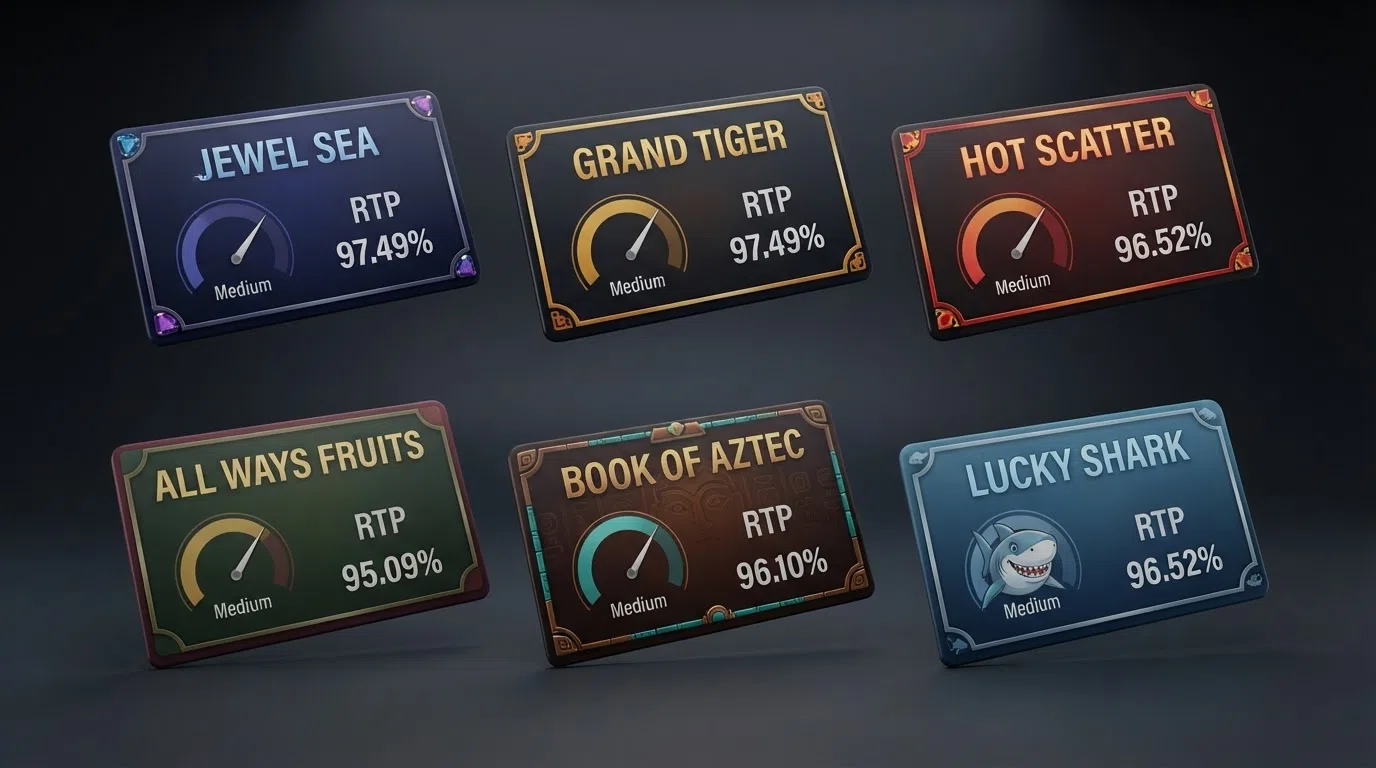
The Amatic catalogue holds more than 250 titles, but only six carry independently verified RTP figures in the sources available to this page. The table below shows what is known, with the no-data marker for the columns the data does not cover.
| Slot Title | RTP | Volatility | Max Win | Reels and Format |
|---|---|---|---|---|
| Book of Aztec | 95.09% (default; range 90.57%–97.63%) | Medium | 5,000× | 5×3, 10 paylines |
| All Ways Hot Fruits | 97.05% | Medium | 500× | 5 reels, 3 rows, 243 ways |
| Diamond Monkey | 97.49% | Medium | 1,000× | 5×4 |
| Hot Fruits 100 | 96.34% | Medium | — | 5 reels, 100 paylines |
| Admiral Nelson | 97% | Medium | — | — |
| Grand Casanova | 97.49% | — | — | 5 reels |
The “—” entries are the cells where the data does not run. Admiral Nelson’s max win and reel format, and Grand Casanova’s volatility and max win, are not in the research set, and the cells stay empty rather than guessed.
The Six Amatic Slots with Published RTP Data
The reason the table is six rows and not two hundred is structural. Slot RTPs are not a public dataset in the UK; they are disclosed by the operator at the point of play (in the game’s help or information panel) and aggregated by a small number of casino comparison sites. Where an operator has not configured a title for the UK market, or where the comparison sites have not catalogued it, the figure simply does not exist in the public record. Amatic’s full catalogue of 250-plus titles is configured at most of the ten operators on this page, but the per-title figures cluster around the half-dozen slots that comparison sites have actually tabulated.
The RTP spread across the six is wide. Book of Aztec’s default 95.09% sits 0.83 percentage points below Diamond Monkey and Grand Casanova’s 97.49% — and the Book of Aztec figure is itself only the default within a variable range of 90.57% to 97.63% that the operator can set. In other words, a player who thinks they are playing Book of Aztec at 95.09% may be playing it at 90.57% at a different operator, with the headline number the same and the long-run return a full seven percentage points lower. The volatility is medium across the six, with a single “—” entry where the figure was not captured, and the max-win figures range from 500× (All Ways Hot Fruits) to 5,000× (Book of Aztec). The 5,000× ceiling on Book of Aztec is the largest in the set, and it sits behind a stake cap of £5 for over-25s and £2 for under-25s — meaning the maximum single-spin return is £25,000 for an over-25 player and £10,000 for a younger one.
What Amatic’s RTP Range and Volatility Mean for Your Session
The catalogue average of 96.33% RTP across 206 indexed slots is a useful baseline, and it tells a player two things at once. The first is that Amatic sits slightly below the broader industry mean (closer to 96.5%) and well below the 97%–98% bracket of the highest-RTP studios. The second is that medium volatility — the dominant profile — produces a session shape that holds attention over an evening: longer dry stretches than a low-variance slot, and rarer peak payouts than a high-volatility one. For a player with a session budget in the £50–£200 range, that shape is usually a better fit than a high-volatility title that burns the bankroll before a feature triggers.
The practical difference between a 95% RTP slot and a 97.5% RTP slot at £1 per spin over an hour is not subtle. Run 600 spins at 95% and the house edge takes £30; run the same number at 97.5% and the house edge takes £15. That is a real-money difference that compounds over a session, and it is the reason the table above matters: the 2.5-percentage-point spread between Book of Aztec’s default and Diamond Monkey’s verified figure is worth knowing before the deposit goes in.
The operator-selected RTP band is the harder variable. The same Book of Aztec title can return 90.57% or 97.63% depending on the operator’s configuration, and a player has no way to know the configured figure without opening the in-game help panel at the casino where they intend to play. That is the single most important pre-deposit check on this page: open the slot, find the RTP in the help or information section, confirm the figure, and only then decide whether the title is worth the session.
Amatic Slot Features, Mechanics and Progressive Jackpots
The Amatic catalogue carries the full spread of bonus mechanics a UK player expects, with two qualifications. The first is that the bonus-buy feature — a button that lets a player pay a multiple of stake to trigger a feature round directly — is enabled on a subset of Amatic titles rather than across the board, and the cost varies by game. The second is that progressive jackpot Amatic slots exist but the seed and ceiling figures are not in the public dataset, which means a player chasing a progressive should check the current pool at the operator before playing rather than relying on a third-party summary.
Daily slot tournaments, where Amatic titles are a regular feature at several of the operators on this list, are a separate layer of the product. The structure is a fixed prize pool split across the top finishers on a leaderboard, with the entry either free (funded by the operator) or paid (with a stake contribution to the pool). The prize pools are typically in the low thousands of pounds, and the volume of qualifying spins means a tournament is closer to a £5–£20 session than a high-roller product.
The classic fruit-machine mechanics that survive in Amatic’s online catalogue — hold, nudge, gamble ladder — are the part of the inheritance that the land-based years show most clearly. The gamble ladder in particular is a holdover from the physical cabinet: a winning spin offers a double-or-nothing climb, with the player choosing when to bank. It is a high-variance feature on top of a medium-volatility base, and it is the part of the catalogue a UK player should treat as entertainment cost, not strategy.
Why Your Amatic Casino Bonus Is Smaller Than It Looks
A welcome bonus’s headline number is a marketing surface, and the real cost is the gap between that number and the money that ends up withdrawable. The arithmetic on the Casumo offer — a 50% deposit bonus up to £100, with 10× wagering on the bonus amount, on an Amatic slot at the 96.33% catalogue average RTP — runs as follows. Required turnover is the bonus (£100) multiplied by the wagering factor (10×), giving £1,000 of qualifying bets. The expected loss on that turnover at 96.33% RTP is the turnover multiplied by the house edge (1 minus 0.9633), or roughly £37 in long-run theoretical cost. That is the bonus’s real price to the player: £37 in expected losses to clear £100 of bonus money, before any consideration of the time, the variance and the £20 minimum deposit needed to claim it.
The £37 figure is an average over many spins under the stated assumptions — not a guaranteed outcome for any single player. A short session can return more or less than the long-run expectation, and the £37 cost is what the bonus is worth in expectation, not in any particular run.
No-Deposit Free Spins and Sign-Up Offers at UK Amatic Casinos
No-deposit free spins on Amatic titles are scarce in the UK market. The two operators on this list that run a no-deposit free-spin component are Betfair (50 spins on registration) and Virgin Games (30 spins via the Mega Reel mechanic). Both batches carry wagering terms that were not fully captured in primary source during research, which means the actual cash value of the spins depends on conditions a player should verify at the casino before claiming. The standard pattern across UK free-spin campaigns is that the spins are restricted to a small set of high-volume provider titles — Pragmatic Play at 888, for example — and Amatic is typically not in the eligible-game list. A player who values Amatic specifically will spend the no-deposit spins on whatever the operator offers, then use a separate deposit to run the Amatic catalogue.
What a no-deposit free-spin is actually worth at the standard £0.10 per spin, with a £300 maximum cashout cap, is a small but non-zero figure. Fifty spins at £0.10 with no wagering and a £300 cap is worth up to £5 of stake-equivalent and up to £300 of cashout — but the realistic return over fifty spins on a 96% RTP slot is closer to £4 of stake-equivalent value in cash, not £300. The cap matters when a player hits a peak win; the long-run expectation matters when they do not.
Welcome and First-Deposit Bonuses
Three shapes of welcome offer appear across the ten operators on this list. The first is a deposit-match package: Casumo’s 50% to £100, with 10× wagering and a £20 minimum deposit, is the cleanest example. The second is a free-spin package: 888’s 100 spins on a £10 deposit, Paddy Power’s 60 spins, Betfair’s 150 total spins (50 no-deposit plus 100 on deposit). The third is a no-wagering model: Sky Vegas, where bonus winnings are withdrawable without a playthrough requirement.
The 10× cap that came into force on 19 December 2025 changed the offer landscape. Pre-reform, a 35× or 50× wagering requirement was the UK norm; the post-reform ceiling is 10×, which is the same multiplier Casumo publishes and the same multiplier 888 publishes. LeoVegas’s widely-cited 35× international figure is not the UK offer. The audit will not catch a comparison site that prints the 35× figure on a UK page; only a player who reads the operator’s own UK terms before depositing will.
The £20 minimum deposit on Casumo’s bonus is the signal that the offer is targeted at players who intend to run a session, not at players looking for a no-stake trial. A £20 deposit, a £10 bonus credit at 50% match, and £100 of required turnover at 10× is a 5× multiple of the deposit in bonus-related action — heavier than the 888 free-spin offer on a per-deposit basis, and the right shape for a player who has already decided on the session.
What the 10× Wagering Cap Means for Bonus Value
The 10× cap is the arithmetic break that makes post-reform UK bonuses worth running. A £100 bonus at the pre-reform 35× norm required £3,500 of turnover, which on a 96.33% RTP slot cost the player about £129 in expected losses. The same £100 bonus at 10× requires £1,000 of turnover and costs about £37. The £92 saving on a single bonus is the difference between a marketing token and a usable offer, and it is the single most important number on this page for any player who weighs bonuses on what they cost rather than what they advertise.
The 10× cap also came with a ban on mixed-product promotional offers, which closes the door on a casino forcing a slots bonus to be cleared on blackjack or roulette. The bonus is now restricted to the product the offer is attached to, which means a slots bonus clears on slots, a live-casino bonus clears on live-casino, and the two do not cross. That is a structural improvement for the player and a reason the post-reform offer landscape is genuinely better than the pre-reform one.
A no-wagering offer, like Sky Vegas’s model, is mathematically superior to a 10× wagered offer on an Amatic slot at 96.33% RTP. The expected cost of clearing a no-wagering bonus is zero, by construction. The trade-off is the headline amount, which is typically lower than a 10×-wagered alternative, and the player has to weigh the smaller certain value against the larger conditional value. For a player with a short horizon and a fixed budget, the no-wagering offer wins. For a player who runs longer sessions and is comfortable with variance, the 10×-wagered offer with the higher headline can pay out more in expectation. The honest answer is that the no-wagering offer is the better expected value at every session length, and the player who picks the 10× alternative is paying a £37 premium for the chance at a larger headline payout.
Getting Money In and Out: Payments at UK Amatic Casinos
The credit card ban is the first fact a UK player needs about payments. Since 14 April 2025 — actually 14 April 2020, with the 2025 date in the research appearing as a separate instrument — every credit card, including credit-card-funded e-wallet deposits, has been blocked for remote gambling under UKGC licence condition 6.1.2. A deposit attempted from a credit card will be declined at the cashier. A PayPal or Skrill account funded by a credit card is also blocked. The route left is a debit card or a non-credit-funded e-wallet, and the cashier screen at a UKGC-licensed operator will reject anything else.
The second fact is that e-wallets are the fastest withdrawal route. PayPal, Paysafecard and Trustly are the names that recur across the operators on this list, and a PayPal or Trustly withdrawal typically clears in hours once the operator’s pending period is done. A debit card withdrawal runs 3–5 business days on top of the pending period. The headline withdrawal time on a casino’s marketing page is almost always the time from approval to receipt, not the time from request to receipt, and the difference is the operator’s pending-period queue.
E-Wallets, Debit Cards and the Post-Credit-Card Payment Landscape
The credit card ban’s scope is wider than most players expect. The 14 April 2020 instrument covers every remote gambling payment, which means a PayPal account funded from a credit card is also out of bounds — the ban operates at the source of the funds, not at the destination. A player who routinely tops up an e-wallet from a credit card needs to switch to a debit-source funding path before the e-wallet is usable at a UK casino.
The UKGC’s deposit-limit prompt rule, in force from 31 October 2025, means that the cashier screen now requires a player to set a financial limit before the first deposit clears. Decreases to the limit are immediate; increases are subject to a cooling-off period. A player who sets a £200 weekly limit and then tries to raise it to £500 mid-week will not see the new limit until the cooling-off has run. The “gross deposit limit” terminology rule (RTS 12) restricts the label “deposit limit” to a limit that includes any bonus funds wagered back into the deposit balance, which closes the loophole of an operator advertising a “deposit limit” that quietly excludes bonus turnover.
For a player with a fixed bankroll, the practical effect of the deposit-limit prompt is positive. The limit is set before the first deposit, the player cannot silently raise it, and the cashier screen at every UKGC-licensed operator now carries the same prompt. The rule is the first UKGC instrument that puts a hard behavioural step in front of every deposit, regardless of the operator.
Low-Deposit Casinos, Withdrawal Speed and What Actually Delays Your Payout
The £5 minimum deposit is a category that exists in the UK market, but the per-operator minimums vary by payment method and are not consistently published. A player who wants a low-deposit entry point should check the cashier at the specific operator before sign-up rather than rely on a third-party summary. What the research confirms is the structural ceiling on minimums — the bonus eligibility minimum at Casumo is £20, for example, while the deposit floor at the cashier is typically lower.
KYC is the checkpoint that delays more withdrawals than the payment rail. Since 7 May 2019, identity verification — name, address, date of birth — has been mandatory at every UKGC-licensed operator before any deposit or gambling. A player who passes KYC at sign-up and keeps their documents current rarely hits a withdrawal delay. A player who registers without verifying, or whose document expires between sign-up and withdrawal, hits the verification queue at the worst possible moment. The right move is to upload the KYC documents at registration and re-verify the moment the operator prompts for a refresh, rather than waiting until a withdrawal is requested.
The 72-hour pending period many operators impose is the third variable, and the one that matters most for headline withdrawal times. A PayPal withdrawal that the operator’s marketing page claims is “instant” is instant only after the pending period — the queue between the withdrawal request and the operator’s release of the funds — is cleared. The pending period exists for security and anti-fraud reasons, and it is the single biggest reason a fast e-wallet withdrawal is not actually fast.
Playing Amatic Slots on Mobile: No App Required
Every Amatic slot runs in a mobile browser without an app, a download or a plug-in. That is the headline, and the reason for it is the catalogue’s HTML5 architecture: the same code that runs the slot in a desktop browser runs it in Safari on iOS or Chrome on Android, with the touch-optimised controls that make a phone spin button work. The page count for a player who tries to install a casino app to play Amatic slots is exactly zero, because the casino app offers nothing the browser does not.

How HTML5 Puts Every Amatic Title in Your Mobile Browser
The technical fact behind the claim is that HTML5 slots render natively in the browser engine, without a bridge layer between the device and the game. The casino’s game lobby is a web page; the Amatic slot embedded in it is a web component; the phone’s browser renders both without intermediate translation. That is the difference between an HTML5 slot and the older Flash-based model, where a plug-in sat between the browser and the game and broke every time the operating system updated. HTML5 is the operating system’s native web format, and the catalogue’s mobile-first design means the layout, the spin button and the paytable are sized for touch from the start rather than scaled down from a desktop design.
The performance characteristic that comes out of the mobile-first design is the lightweight code base. Amatic’s slots are smaller in download size than most of the high-animation catalogue competitors, which means they load quickly on a mid-range phone and run without frame drops on a 2019 device. A 5G connection is not required; a 4G connection with a reasonable signal is enough, and the games degrade gracefully on a 3G fallback rather than freezing. The catalogue’s low-latency design is a deliberate engineering choice, and it is the practical reason an Amatic slot on a phone feels closer to a cabinet spin than a streaming video.
The UKGC’s 2.5-second minimum spin speed, in force since 31 October 2021, interacts with the mobile experience in a way that matters. A slot configured to spin at sub-2.5-second cadence cannot be legally offered at a UKGC-licensed operator, and the catalogue’s HTML5 architecture means the speed limit is enforced in the code itself, not by the operator’s platform. The player does not see a faster spin even if their phone could render one, and the audit on the operator’s compliance side means the limit is not a marketing claim.
Dedicated Casino Apps for iOS and Android
A subset of the ten operators on this list publishes a dedicated iOS or Android app — Sky Vegas, Betfair, Paddy Power, Ladbrokes and a few others run native apps alongside their browser product. The app experience and the browser experience are functionally identical for Amatic content, because the game library is server-side: the same games are delivered to the app and to the browser, and the Amatic slot running in the Sky Vegas app is the same Amatic slot running in the Sky Vegas mobile site. The only differences are app-side features — push notifications for bonus expiry, biometric login, the occasional app-exclusive promotion — none of which affect the game itself.
A player who values the convenience of push notifications and biometric login will use the app. A player who values not having casino apps on their phone and a smaller storage footprint will use the browser. Either way, the Amatic catalogue plays identically, and the choice between app and browser is a personal-storage decision rather than a game-quality one.
Crypto, Bitcoin and Amatic Casinos: The Reality for UK Players
There is no UKGC-licensed casino that offers cryptocurrency as a standard deposit method, and the search results that suggest otherwise are pointing at unlicensed offshore sites. The licensed market does not feature crypto as a payment rail, and the search queries that produce “crypto Amatic casino UK” results are returning brands operating outside the GB licence perimeter. The regulatory status of crypto at GB-licensed operators is not that a rule prohibits it; it is that the licensed market has not adopted it. The two statements sound similar and they are not.
What You Lose When You Play Amatic Slots at an Unlicensed Crypto Casino
A player who deposits crypto at an unlicensed “Amatic casino” is, in regulatory terms, gambling at a site that is not licensed to serve GB customers. Section 33 of the Gambling Act 2005 makes providing gambling facilities without a licence a criminal offence, and while the enforcement focus is on the operator rather than the player, the player loses every UK protection the moment the deposit goes to an unlicensed site.
The first thing that disappears is GAMSTOP coverage. GAMSTOP is a licence-bound self-exclusion scheme; an unlicensed site has no obligation to honour a GAMSTOP registration, and most do not check. A player who has self-excluded through GAMSTOP and then opens an account at an unlicensed crypto casino is gambling without the protection they specifically asked for. The second is the £5 / £2 stake cap, which is a UKGC licence condition rather than a statute. An offshore site is not bound by it, and a player with a self-imposed stake limit who finds the limit unenforceable at an unlicensed site is in the worst possible position. The third is the UKGC complaints route and the ADR provider: a withdrawal that is withheld at a licensed operator can be appealed through the regulator and the ADR; a withdrawal that is withheld at an unlicensed operator has no UK regulatory backstop.
The UKGC’s enforcement model is disruption rather than ISP blocking. Between April 2024 and June 2025, the regulator issued 3,140 disruption notices, referred 447,778 URLs to search engines, and saw 287,961 URLs removed, with a 32% average fall in engagement across the 160 disrupted sites. The numbers are real, and the model is producing measurable results, but it is not a block at the network level. A player who seeks out an unlicensed crypto Amatic casino will find one; the regulator’s job is to make the search harder, not to make the destination unreachable.
A player who values the protections the UK system provides — GAMSTOP, the stake cap, the complaints route, the ADR access, the financial vulnerability checks, the deposit-limit prompt — will play at a UKGC-licensed operator. The crypto angle is a feature of the unlicensed market, and the trade-off is the protection that comes with the licence.
Licensing, Safety and What the UKGC Actually Requires
The single most important fact about Amatic and the UK market is the licence distinction. Amatic Industries GmbH holds UKGC account 47992 as a B2B Gambling Software Remote supplier. It does not hold a consumer-facing operating licence, and it does not run a UK casino. The games reach UK players through operators who hold their own B2C licences — every operator on this list is one of them, and the licence reference for each is on the UKGC public register. A player who sees “Amatic is UKGC licensed” on a comparison site is reading a true sentence that is doing the wrong work. The licence authorises Amatic to supply software; it does not authorise a UK player to bypass the operator’s own licence.
Amatic’s B2B UKGC Licence: What Registration 47992 Actually Means
The B2B Gambling Software Remote licence is a defined category under the LCCP. It permits the holder to supply gaming software to UKGC-licensed operators, who integrate the software into their own product and offer it to their own customers. The supplier is not in the customer relationship; the operator is. A player who has a complaint about an Amatic slot at Sky Vegas takes the complaint to Sky Vegas and, if necessary, to the UKGC and the ADR — not to Amatic. A player who has a complaint about a payment at a UKGC-licensed operator takes it to the operator and, if necessary, to the UKGC — not to the supplier.
The £500 regulatory penalty that the UKGC imposed on Amatic Industries GmbH for breaching licence condition 15.3.1 (general and regulatory returns) is the only public regulatory action against the supplier on the register. The penalty is minor in absolute terms — a fraction of the cost of the licence itself — and it relates to the late submission of regulatory returns rather than to game integrity, player protection or anti-money-laundering controls. The action does not represent a licence review or a suspension, and the licence has remained active since its grant on 27 April 2017. The certification footprint that comes with the licence — UK, Malta, Sweden, Spain, Colombia, Romania, Bulgaria, Croatia, Belarus and Bosnia-Herzegovina — is a useful signal of the supplier’s regulatory maturity across multiple regimes, and it is the reason an Amatic slot is the same game at a UKGC casino and at a Romanian ONJN casino.
How UKGC Regulation Protects Every Amatic Slot Spin
The UK player protection stack that wraps around an Amatic slot is dense, and most of it is invisible until it matters. The age-banded stake cap is the most direct limit on the spin itself: £5 per game cycle for players aged 25 and over (in force from 9 April 2025), £2 for players aged 18 to 24 (in force from 21 May 2025), imposed by the Gambling Act 2005 (Operating Licence Conditions Amendment) Regulations 2025. The cap cannot be defeated by splitting a stake across multiple sub-spins within a single game cycle. For a player running Book of Aztec at the 5,000× max win, the maximum single-spin return is £25,000 at age 25+ and £10,000 at age 18–24.
The game-design rules in force since 31 October 2021 close the design-side loopholes. Auto-play is banned; the minimum spin speed is 2.5 seconds; features that speed up play are banned; losses disguised as wins are banned; reverse withdrawals are permanently banned; and the operator must display total losses, total wins and time played during a slots session. The combined effect is that the slot cannot be designed to disguise losses as wins, cannot be played faster than the regulator’s pace, and cannot withdraw a player-requested cancellation once the funds are in the cash balance. For an Amatic player, the rule that bites hardest is the spin-speed floor: the catalogue’s HTML5 architecture is well-suited to a 2.5-second minimum, but the rule prevents an operator from offering an accelerated-spin configuration that would otherwise be technically possible.
Identity verification before any deposit or gambling, in force since 7 May 2019, is the rule that determines the speed of the cashier. A player who has verified at sign-up does not see a delay at withdrawal; a player who has not verified, or whose document has expired, sees the verification queue at the worst possible moment. The rule is the reason “no verification casino” is a contradiction in UK terms: a site that waives KYC is either unlicensed or in breach, and a player who values the speed of a no-KYC cashier is implicitly trading it for the protections the KYC check is part of.
GamStop, Non-GamStop Casinos and Why “No Verification” Means No Licence
GAMSTOP is the national multi-operator self-exclusion scheme, and it has been a mandatory condition of every UKGC online operating licence since 31 March 2020. A player who registers with GAMSTOP is excluded from every UKGC-licensed online operator at once, for a period of six months, one year, five years, or five years with auto-renewal. The exclusion cannot be cancelled early. The mechanism is the most powerful player-protection tool in the UK online market, and it is the reason a UK player who has decided to stop gambling can stop completely rather than operator-by-operator.
The “non-GamStop Amatic casino” search results are pointing at sites that are not licensed by the UKGC. An unlicensed site has no obligation to integrate with GAMSTOP, and most do not. A player who has self-excluded through GAMSTOP and then opens an account at a “non-GamStop” site has broken their own self-exclusion by routing around the mechanism, and the protection the exclusion was designed to provide is not in place. The honest reading of “non-GamStop casino” is “unlicensed offshore site,” and the honest reading of “no verification casino” is “either unlicensed or in breach of a UKGC licence condition that has been mandatory since 2019.”
The GB licence perimeter covers England, Scotland and Wales. Northern Ireland runs on separate, older gambling law, and a UK-facing site licensed for the GB market is not automatically licensed for Northern Irish customers. A player based in Northern Ireland should check the operator’s Northern Irish availability separately, and the rest of the UK player-protection stack described on this page applies to the GB market rather than to Northern Ireland specifically.
Responsible Gambling: Tools That Work and Help That Is Free
The player-protection stack at a UKGC-licensed Amatic casino is not a single tool; it is a sequence of instruments, each addressing a different point in the session. The prevalence data behind the instruments is the NHS Adult Psychiatric Morbidity Survey 2023–24, which puts problem gambling (PGSI 8+) at 0.4% of English adults, moderate risk (PGSI 3+) at 1.6%, with men at 2.2% and women at 1.0%, and the 25–34 age group highest at 3.5%. The instruments exist because those numbers, small in relative terms, are large in absolute terms — 1.6 million adults in England may benefit from some form of treatment or support, and almost 1 in 3 (30%) adults who gamble and are experiencing any level of problems want treatment, support or advice, nearly double the 17% figure from 2020.
Deposit Limits, Reality Checks and the Tools Every UK Amatic Casino Must Offer
The mandatory deposit-limit prompt, in force from 31 October 2025, requires the operator to offer a player a financial limit before the first deposit clears. Decreases to the limit take effect immediately; increases are subject to a cooling-off period. The “gross deposit limit” terminology rule (RTS 12) means only a limit that includes any bonus funds wagered back into the deposit balance can be labelled a “deposit limit” — a softer label, like “spending cap,” is not a substitute. The rule closes the loophole of an operator offering a “limit” that quietly excludes bonus turnover and gives the player a smaller protection than the label implies.
Reality checks are the session-time pop-ups that show the player how long they have been playing and the net position for the session. They are mandatory at every UKGC-licensed operator, and the intervals vary by operator. A player who wants a hard interruption can set the reality-check interval to fifteen minutes; a player who wants a gentle nudge can leave it at the default of an hour. The settings are player-controlled, and the operator cannot disable the prompt.
The £150 net-deposit threshold for financial vulnerability checks, in force from 28 February 2025, is the point at which the operator runs an automated check against publicly available data — bankruptcy orders, county court judgments, individual voluntary arrangements, debt relief orders. The check is not a credit check; it does not require documents from the player; it does not affect the player’s credit score. If the check returns a match, the operator is required to take action, which can range from a tailored reality-check prompt to a deposit limit reduction to a temporary account suspension. The rule is the first UKGC instrument that ties a deposit threshold to an automated affordability signal, and it is the regulator’s most direct intervention between the deposit-limit prompt and the full financial risk assessment framework that has been announced but not yet commenced.
Self-Exclusion, GAMSTOP and Where to Get Help Right Now
GAMSTOP is the multi-operator self-exclusion scheme, mandatory for every UKGC-licensed online operator. A registration excludes the player from every UKGC-licensed online casino, for a period of six months, one year, five years, or five years with auto-renewal. The exclusion cannot be cancelled early — once the registration is in place, it runs to the end of the chosen period. The auto-renewal option is the right choice for a player who is not confident the period they have chosen will be long enough; the standard five-year option is the right choice for a player who is.
The National Gambling Helpline, run by GamCare, is free and 24/7 on 0808 8020 133, by phone and by live chat. In January 2026, 996 callers were referred to treatment and peer-based support, up 48% year-on-year from 674 in January 2025. The increase is not a sign that more people are gambling harmfully in absolute terms; it is a sign that more of the people who are gambling harmfully are reaching the help line. The line is the single most useful number on this page for a UK player who is worried about their own gambling or someone else’s.
The wider help infrastructure is NHS gambling harm clinics in England, Scotland and Wales, Gamblers Anonymous, the Primary Care Gambling Service, GamLearn (the Gambling Lived Experience and Recovery Network), and the NICE guideline NG248 on gambling-related harms. The statutory levy that funds the treatment, prevention and research side of this infrastructure came into force on 6 April 2025 at a top rate of 1.1% of gross gambling yield for remote casino and gambling software licences, split 50% to treatment, 30% to prevention and 20% to research. The levy replaced the previous voluntary contribution model, and the binding rate is the first time a UK gambling levy has had a hard statutory anchor.
The Remote Gaming Duty increase from 21% to 40% on 1 April 2026 is the operator-side tax story of the year, and it does not affect the player directly. The player pays no tax on gambling winnings in the UK; the operator pays the duty on its gross gaming yield. The rate increase is a Treasury revenue measure, and its effect on the player is indirect, through any pressure it puts on bonus generosity and on the operator’s margin for player-protection spending.
How We Selected and Ranked Every Amatic Casino on This Page
The ranking on this page is built on three verifiable checks: UKGC licence status, Amatic catalogue depth and bonus-term transparency. The UKGC Public Register is the source for the licence check, and every operator on this list was verified against it. Amatic catalogue depth was assessed qualitatively, by lobby inspection and provider-filter searches at each operator; operators do not publish a per-provider game count, so a numerical ranking on this dimension is not possible. Bonus terms were taken from operator sites where available and noted as unconfirmed where primary sources were silent.
The ranking does not apply a weighting formula, and the order is a qualitative assessment of catalogue depth, bonus fairness under the post-19-December-2025 10× wagering cap, and the transparency with which each operator discloses its terms. The limitations of the methodology are real. Per-title Amatic slot counts are not published, so catalogue depth is a judgment call. Bonus terms for several operators were not confirmed from primary sources during this research run, and the cells in the table above carry the gap rather than a guess. A reader who needs a finer ranking than the qualitative one offered here should run the same checks at the operator’s own site before sign-up.
The competitor pages that dominate the search results for this query rarely tabulate per-title RTP, leave bonus terms vague, and do not cover the age-banded stake cap. The table on this page is the gap closed; the bonus arithmetic is the gap closed; the stake cap, the 10× wagering cap and the KYC requirement are all addressed in context.
Your Amatic Casino Checklist: What Matters and What Does Not
Three checks separate a useful UK Amatic casino from a token listing. The first is Amatic catalogue depth, which is a lobby-search check rather than a published figure: open the casino, filter by Amatic, count the titles. A casino with eight Amatic titles is a different product from one with eighty, and no operator on this list publishes a per-provider count. The second is the bonus maths under the 10× cap, which is a calculation the player can do in thirty seconds: take the bonus amount, multiply by 10, multiply the result by the slot’s house edge (1 minus RTP). For a £100 bonus on an Amatic slot at 96.33% RTP, the result is about £37 of theoretical clearing cost. A no-wagering offer on any slot produces a clearing cost of zero, by construction. The third is whether the casino carries the specific Amatic title the player wants to run; distribution is not uniform across operators, and a player who wants Diamond Monkey specifically should confirm its presence at the casino before depositing.
The three things that do not matter as much as they seem are the headline bonus amount (the wagering multiplier and the slot’s RTP determine the real cost, not the headline), the withdrawal speed claim (the operator’s pending period is the bottleneck, not the payment rail), and whether the casino has a mobile app (the Amatic catalogue runs identically in the browser, and the app is a convenience feature rather than a game-quality one). The £5 / £2 stake cap, the credit card ban, the 10× wagering cap, the GAMSTOP coverage and the £150 vulnerability check are the same at every UKGC-licensed operator on this list, and the comparison between operators comes down to catalogue depth, bonus terms and the in-game help panel that shows the actual configured RTP for the slot the player intends to run.
Frequently Asked Questions About Amatic Online Casinos in the UK
Are Amatic slots available at UK-licensed online casinos?
Yes. Amatic Industries holds a UK Gambling Commission B2B Gambling Software Remote licence under account 47992, active since 27 April 2017, and its games are integrated into the lobbies of multiple UKGC-licensed operators including the ten on this page. The catalogue runs to 250-plus HTML5 titles, and the distribution is not uniform across operators — a player should filter by Amatic in the lobby to confirm the specific titles carried at a given casino before signing up.
Can I claim a bonus at an Amatic casino without making a deposit?
Some of them. Betfair Casino offers 50 no-deposit free spins on registration as the first stage of its welcome package, and Virgin Games offers 30 no-deposit spins through its Mega Reel mechanic. Both batches are restricted to a small set of eligible titles rather than the full Amatic catalogue, and the wagering and validity terms should be verified on the operator’s own UK site at the point of claim. No-deposit offers at UKGC-licensed casinos are the exception rather than the norm.
What is the maximum stake allowed on Amatic online slots in the UK?
The maximum stake per game cycle is age-banded: £5 for players aged 25 and over, in force from 9 April 2025, and £2 for players aged 18 to 24, in force from 21 May 2025, under the Gambling Act 2005 (Operating Licence Conditions Amendment) Regulations 2025. The cap cannot be defeated by splitting a stake across multiple sub-spins within a single game cycle, and it applies to every online slot at every UKGC-licensed operator, Amatic titles included.
How do Amatic slots compare to other providers for payout rates?
The Amatic catalogue averages 96.33% RTP across 206 indexed slots, with the majority at medium volatility. That places Amatic slightly below the broader industry mean (around 96.5%) and below the 97%–98% bracket of the highest-RTP studios. The spread within the catalogue is wide: Book of Aztec’s default 95.09% is more than two percentage points below Diamond Monkey and Grand Casanova’s 97.49%, and the operator can configure the figure within a variable range that differs by title.
Can I play Amatic slots for free in demo mode at UK casinos?
Demo mode is available on most Amatic titles at the UKGC-licensed operators that carry them — Sky Vegas, Betfair, 888, Casumo and LeoVegas confirm demo availability in the research. The play-money mode is the right pre-deposit check for the operator-configured RTP band, which the player can read in the slot’s help or information panel. Progressive jackpot titles are typically exempt from demo mode across the UK market.
What payment methods can I use at Amatic online casinos in the UK?
Debit cards, PayPal, Paysafecard, Trustly and bank transfer are the standard routes at UKGC-licensed operators. Credit cards have been banned for all remote gambling since 14 April 2020, including credit-card-funded e-wallet deposits, under UKGC licence condition 6.1.2. Cryptocurrency is not a standard payment method at any UKGC-licensed casino, and the sites that offer it are operating outside the GB licence perimeter.
Providers – Casinos That Accept Bitcoin UK
Content created by the «Casinos That Accept Bitcoin UK» team