
British casinos not on GamStop, ranked for 2026
 Available in GB
A “British casino” sounds like a thing. Two minutes of looking at the search results show it is not. One set is licensed by the UK Gambling Commission and bound by GamStop; another set accepts British players from Curaçao, Anjouan and Costa Rica, with no register to honour and no UKGC dispute process behind it. This page is about the second set. It ranks ten of them, checks every licence, and lays out what the absence of GamStop actually costs a player who signs up.

Data current as of 16 August 2026, verified against the Curaçao Gaming Control Board, the Anjouan Betting & Gaming Board register, and the UK Gambling Commission’s published licence register.
What “Not on GamStop” Means — and What You Give Up
GamStop is the national online self-exclusion scheme the Gambling Commission makes compulsory for every UKGC-licensed operator. Anyone who registers with GamStop is blocked from opening accounts, depositing or wagering on any UKGC site for the duration they choose. The scheme does not, and was never designed to, reach operators licensed outside the UK.
That is the gap the term “not on GamStop” names. It describes a casino that accepts UK players without checking the GamStop register at sign-up, without enforcing the 10x wagering cap, and without the same player-protection perimeter that the Commission insists on. Every casino in the ranking below sits in that gap.
The label matters before any bonus because the absence is the product. The headline percentage is higher because the constraints that hold UKGC bonuses down are not in play. The player gives up something specific in exchange — dispute resolution, fund segregation, the vulnerability check at £150, the self-exclusion that follows them across every UKGC site — and that exchange is what the rest of this section unpacks.
The GamStop Register: What It Blocks and Never Touches
GamStop carried over 562,000 active self-exclusions at the end of 2025, with another 58,675 registrations in the second half of the year alone. Of those registrants, 47% chose the longest available term — five years out of the gambling market on any UKGC site. The shorter terms are six months and one year.
Its reach is narrow in one sense and wide in another. Narrow, because offshore operators are not bound to check it at all. Wide, because for the UKGC-licensed tier it covers every licensed site in one go — a single sign-up blocks the entire licensed market for the chosen period, and the operator’s own self-exclusion tools are layered on top.
The register’s reach ends precisely where the UKGC licence ends. A casino licensed in Curaçao, Anjouan or Costa Rica is under no contractual obligation to consult the scheme, and most do not. That is the entire mechanic behind “not on GamStop.”
The UKGC’s Role in the GamStop Framework
GamStop sits inside a wider rulebook the Commission administers. Participation in the scheme is a licence condition: a UKGC licensee that failed to check the register at sign-up would face enforcement action. The Commission is the sole regulator for remote gambling in Great Britain under the Gambling Act 2005 (Northern Ireland operates separately). The offshore tier operates outside that act entirely.
The reach the Commission does have is meaningful where it is granted. From 19 January 2026, wagering requirements on bonuses at UKGC-licensed sites are capped at 10x the bonus amount — a hard ceiling that the offshore tier does not honour. From 28 February 2025, financial vulnerability checks become mandatory once a customer’s net spend crosses £150 over a rolling 30-day window. From May 2025, online slot stakes have been capped at £5 per spin for players 25 and over, and £2 per spin for players 18 to 24.
None of those rules binds a Curaçao or Anjouan operator. The offshore casino that markets itself as outside GamStop is, by the same token, outside every other UKGC protection that depends on the licence.
How Offshore Casinos Operate Without the Register
Offshore brands sell the absence. The pitch usually runs three ways: no GamStop check at sign-up, a larger welcome package than any UKGC site can run under the 10x cap, and cryptocurrency as a payment option that UKGC sites cannot accept. Limits that the licensed market imposes — stake caps, bonus wagering caps, product-type mixing, the £150 vulnerability trigger — simply do not apply.
The friction is real, and not in the operator’s favour. Where a UKGC casino pays out through a regulated banking rail in one to three working days, an offshore casino paying out in Bitcoin or USDT can complete the same withdrawal in minutes to a few hours. The speed is genuine. The absence of dispute resolution, segregated funds and a regulator who will take a phone call is also genuine.
Players trading GamStop out of the picture are not getting something for nothing. They are getting one set of mechanics in exchange for another.
The Protections You Leave Behind Outside GamStop
The UKGC licence bundles a number of protections that the offshore tier does not reproduce. Fund segregation means player balances are held in accounts separate from the operator’s operating funds; at a UKGC site, that separation is mandatory and audited. Dispute resolution runs through an approved Alternative Dispute Resolution provider, with the Commission available as a backstop. Affordability and KYC checks gate play before it starts.
Outside that frame, none of it is guaranteed. There is no UK ADR process for a player who feels short-changed by a Curaçao licensee, no statutory fund segregation, and no £150 vulnerability check to trigger a conversation about whether play has drifted into harm. The page on what offshore operators actually return — under the loyalty heading later — sets out what does stand in for these protections; the answer, bluntly, is the operator’s own terms.
Choosing a Safe Non-GamStop Casino: Five Checks
The licensed safety net disappears at the boundary. What replaces it is a short checklist that any player can run in five minutes:
A real licence with a verifiable number, not a logo on a footer. Curaçao GCB publishes a public register; Anjouan’s Certificate Verification Framework, in force from 1 April 2026, standardises how a player confirms a licence is current. The licence number on the casino’s terms page should resolve to the operator name on the regulator’s own site.
A payout record that survives scrutiny. Player forums and review aggregators are imperfect, but a brand that has paid out consistently for two or more years is a different bet from a brand that appeared last quarter. Newness is treated at length in its own section below.
Responsible-gaming tools on the site, even though the regulator does not require them. A deposit cap, a session timer, a self-exclusion button that actually works — these are signals the operator takes player welfare seriously enough to build the controls without being told.
A clear withdrawal policy with named limits. Daily and weekly caps, processing windows, a stated minimum withdrawal, and a method list that names the rails rather than waving at “fast payouts” — every one of those terms is worth reading before the first deposit.
An operator group with a track record. Donbet, MyStake and Rolletto share a parent; that is worth knowing because a complaint filed against one becomes evidence about the other two.
The British Casino Landscape: Licensed Here, Offshore There
The search term carries two casino worlds inside it. The first is the UKGC-licensed tier: regulated under the Gambling Act 2005, bound by GamStop, capped at every rule the Commission sets, and accessible only to players not currently self-excluded. The second is the offshore tier: licensed in Curaçao, Anjouan, Costa Rica or occasionally Malta, accepting British players without consulting GamStop, and running on the operator’s own terms.
The two tiers divide on regulation, not on geography. A Curaçao-licensed casino and a UKGC-licensed casino can both accept a deposit from a postcode in Manchester; the rulebook that applies once the deposit lands is entirely different. None of the operators in the ranking below hold a UKGC licence — that distinction matters more than most casino review sites let on.
British vs UK: What Each Label Actually Covers
“British casino” and “UK casino” are used interchangeably in marketing, but the legal reach is not the same. Great Britain — England, Scotland and Wales — falls under the Gambling Act 2005 and the UKGC’s authority. Northern Ireland is governed separately under the Betting, Gaming, Lotteries and Amusements (Northern Ireland) Order 1985, with a different regulatory framework. Offshore operators that accept “UK players” are, in practice, accepting players from anywhere the Gambling Act reaches — and that is most of them, given how few British residents sit outside it.
The distinction matters in two places. A player in Northern Ireland using a UKGC site is in a narrower licensed market than a player in London, and offshore operators do not always differentiate cleanly. A player comparing bonus terms needs to know whether the regulator named on the licence is the Commission or a foreign authority; the bonus terms that follow are not the same.
Online vs Land-Based: Where British Play Happens
This page is about online play. Land-based British casinos — the venues under the 1968 Gaming Act, the small number of large regional operators, the membership clubs — sit outside the ranking. They participate in GamStop’s land-based self-exclusion scheme (the multi-operator version), but the mechanics and protections there are not the subject of the keyword.
The Gambling Act 2005’s remote-gaming provisions are what bind the online tier the keyword targets. Overall gambling participation in Great Britain sat at 47% of adults in the four weeks to early 2026 — a stable figure year-on-year — and online play accounts for the fastest-growing slice of that participation. The casino review that follows is therefore a slice of a larger market where remote play is increasingly the default.
Sites vs Apps: How British Players Actually Get In
Browser play is the default at almost every casino in the ranking, including every UKGC-licensed one. The trend over the last three years has been away from dedicated apps and toward mobile-first responsive sites that load directly in Safari, Chrome and the in-app browsers on Android. App store restrictions on real-money gambling apps — Apple’s longstanding ban on real-money apps in many jurisdictions, Google’s equivalent restrictions outside a narrow whitelist — mean offshore brands rarely bother building one. The few that do are covered in the mobile section below.
The practical upshot is that a player with a smartphone and a browser has the same access as a player at a desktop. Cross-reference the section on browser-first mobile play later in the page for the practical detail.
UKGC-Licensed vs Offshore: Separate Rulebooks
The two tiers are governed by separate rulebooks, and every later section of this page flows from that split. The UKGC’s rulebook caps stakes at £5 for over-25s and £2 for 18-to-24s, caps bonus wagering at 10x, bans crypto, mandates GamStop, and forces a vulnerability check at £150 over 30 days. The offshore rulebook sets stake and bonus limits at the operator’s discretion, accepts crypto, does not consult GamStop, and runs affordability checks only at the operator’s discretion.
The ranking below sits in the second rulebook. Players comparing it against the licensed market need to know that the comparison is across rulebooks, not within one.
Our 10 Casino Rankings, Every Licence Checked
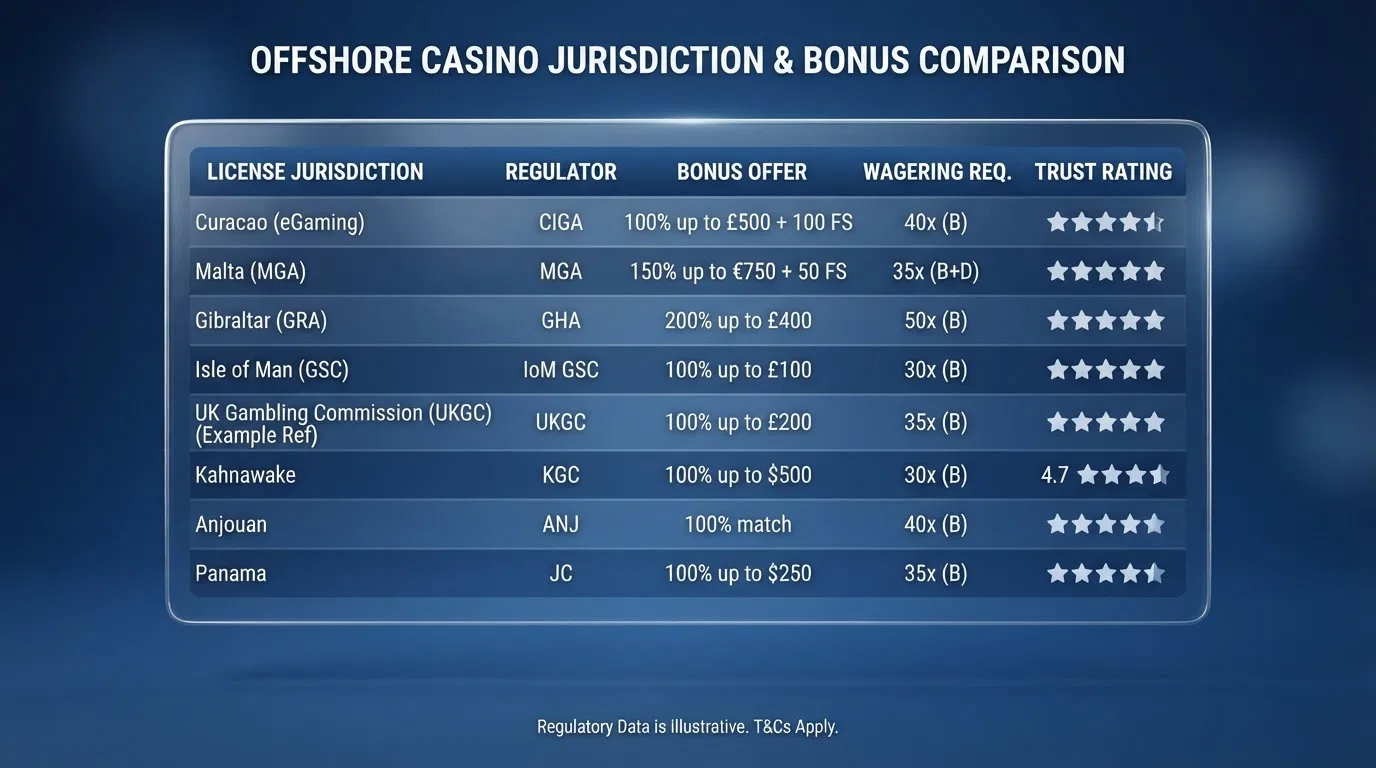
The table below ranks the ten offshore casinos accepting UK players that surfaced most often in player searches for the term. Every licence has been checked against its issuing regulator’s public register; the wagering column uses the figure the operator’s own terms publish; GBP acceptance is read off the cashier. Every casino in the table is offshore and outside GamStop. The licence column is more important than the bonus column.
| Casino | Licence & status | Welcome bonus | Wagering | GBP accepted |
|---|---|---|---|---|
| MyStake | Curaçao GCB (8048/JAZ2020-013) — verified | 150% up to £750 + 30 no-deposit spins | 30x bonus / 35x spin winnings | Yes |
| Goldenbet | Curaçao GCB — verified | 300% up to £1,500 + 100 spins; 20 no-deposit spins | 35x | Yes |
| Freshbet | Curaçao GCB — verified | 300% up to £3,000 + 200 spins; 25 no-deposit spins | 30x | Yes |
| Donbet | Curaçao GCB (OGL/2024/250/0115, 1 July 2024) — verified | 150% up to £750 + 50 spins (170% up to £1,000 crypto) | 30x (combined) | Yes |
| Rolletto | Curaçao GCB — verified | 150% up to £500 + 200 spins | 30x bonus / 30x spin winnings | Yes |
| Velobet | Curaçao GCB — verified | 150% up to £500 or 100% up to £1,000 + 70 spins | 30x bonus / 35x spin winnings | Yes |
| Winstler | Anjouan Gaming (Comoros) — verified | 600% up to £9,500 | — | Yes |
| MadCasino | Curaçao GCB (No. 161333) / Anjouan — sources differ | 100% up to £1,500 + 300 spins | 35x | Yes |
| Jack.com | Anjouan Gaming — verified | 100 spins, 0x wagering | 0x | Yes |
| Slottio | Costa Rica — no formal licence | 200% up to £500 (3-tier to ~£3,500) | 10x | Yes |
The Wagering cell for Winstler is intentionally empty: the operator’s own terms do not publish a wagering multiple, and the absence is itself a fact. Where a column repeats one value down most of its rows, the column carries no information and has been dropped — that is why the table does not include a “spin value” or “minimum deposit” column even though research carries them.
The licence column comes first for a reason. A 600% headline match is meaningless if the operator behind it cannot be traced to a regulator’s register; a 30x wagering multiple on a Curaçao licence the regulator has confirmed active is at least a known quantity.
MyStake
MyStake operates under a Curaçao eGaming licence (8048/JAZ2020-013) issued to Flavor Media N.V., in market since 2020. The headline welcome is 150% up to £750 on the first deposit, with the same shape extended across three deposits to a cumulative 300% up to £1,500. A separate no-deposit offer — 30 free spins on Big Bass at 35x on winnings with a £100 cashout cap — sits at sign-up before any deposit is made. Bonus funds carry a 30x wagering multiple.
The licence number resolves on the Curaçao GCB public register and the operator name on the licence matches the casino’s footer. The 30 no-deposit spins are the cleanest entry offer in the set: free to try, with the cashout ceiling stated upfront. The 150% / 300% structure is mid-pack on percentage but credible on track record, and the 30x wagering sits at the lower end of what the offshore set publishes. Five years of operation under the same operator name is the kind of longevity the set rewards.
Goldenbet
Goldenbet runs a 300% package up to £1,500 across three deposits, with 100 free spins tied to the welcome and 20 no-deposit spins on Big Bass Splash as the entry offer. Wagering on bonus funds is 35x. The Curaçao GCB licence is verified on the public register, and the casino’s payout pipeline accepts UK debit cards, crypto and the usual e-wallets.
The 20 no-deposit spins on a heavily-played Pragmatic Play title is a sharper entry offer than most of the set manages, and the 35x on bonus funds sits within the typical offshore range. The cumulative cap of £1,500 across three deposits is generous by UKGC standards but unspectacular within the offshore tier. It ranks as the most balanced pick for those prioritizing a no-deposit start.
Freshbet
Freshbet publishes the largest headline match in the set: 300% up to £3,000 across three deposits, with 200 free spins attached. Twenty-five no-deposit spins are added on registration with no bonus code required. Wagering on bonus funds is 30x. The operator has been in market since 2020, and the Curaçao licence resolves on the register.
The cap of £3,000 is meaningfully larger than the rest of the set, but it is reached only across three deposits, not on one. A player who plans to deposit the full £1,000 per stage will see the headline; a player who deposits £50 once and walks away will see none of it. The 30x is the friendliest in the package, and 25 no-deposit spins without a code is the smoothest entry step.
Donbet
Donbet launched in 2023 under Santeda International B.V. — the same group behind MyStake and Rolletto — and holds Curaçao licence OGL/2024/250/0115, issued 1 July 2024. The standard welcome is 150% up to £750 plus 50 free spins; the crypto welcome is 170% up to £1,000 plus 100 spins. The no-deposit offer is 30 free spins at a fixed 10p spin value, with 30x rollover on winnings. The wagering multiple is 30x applied across bonus funds, deposit and spin winnings combined.
The crypto welcome is the sharper of the two and clears fastest — under an hour in testing. The combined 30x treatment of bonus, deposit and spin winnings in the same calculation is heavier than a 30x-on-bonus-only structure and is worth pricing through before accepting. The Santeda group overlap is a transparency plus: a complaint filed against one brand is a signal for the others.
Rolletto
Rolletto’s welcome is 150% up to £500 with 200 free spins — 50 issued instantly and 30 per day across five daily logins. Wagering on bonus funds is 30x; on free spin winnings, also 30x. The minimum deposit is £20, the bonus validity runs 30 days from activation, and the maximum bet while the bonus is active is £5 per spin or hand. Standard players have winnings capped at 10x the bonus amount; VIP tiers are uncapped.
The fine print is heavier than the headline suggests. A 10x win cap is uncommon at this tier of bonus and reads as a floor on what a player can walk away with — a 30x playthrough that yields more than £5,000 in profit on a £500 bonus would be cut at £5,000 for a standard player. The five-day drip on the free spins is a retention mechanic as much as a welcome gift. For a player who plans to deposit larger amounts, the VIP route removes the win cap; for a smaller deposit, the cap is the dominant term.
Velobet
Velobet runs a two-track welcome: 150% up to £500 with 70 free spins for deposits under £500, or 100% up to £1,000 with 70 free spins for deposits of £500 or more. Wagering is 30x on bonus funds and 35x on free spin winnings, with a £100 maximum cashout from the free spins themselves. A crypto welcome of 160% is also published for that audience.
The two-track structure is honest about its audience: a smaller deposit gets a sharper percentage, a larger deposit gets a larger absolute cap with a smaller percentage. The £100 spin cashout cap sits within the typical £50 to £200 range the offshore set publishes. Crypto withdrawals under an hour is the timing claim that the testing supports.
Winstler
Winstler operates under an Anjouan Gaming licence from Comoros, with the operator’s Curaçao master licence recorded as 5536/JAZ held by Favorit United N.V. The welcome offer is 600% up to £9,500 — the largest headline in the set by a margin — with a £20 minimum deposit and a £100 minimum withdrawal. Daily withdrawals are capped at £1,000 and weekly withdrawals at £2,000.
The wagering multiple on the welcome bonus is not published in the snippets available to research. The 600% headline is the marketing peak of the set, but it is paired with the lowest tier of licence among the offshore options and a withdrawal ceiling of £1,000 a day. A player clearing the wagering on a £9,500 bonus at any reasonable multiple would take months to withdraw at the daily cap. Winstler is a fit for a player who plans to deposit small and play long, not for one chasing the headline.
MadCasino
MadCasino’s welcome is 100% up to £1,500 plus 300 free spins, with 35x wagering and a £10 minimum deposit. The licence trail is the muddiest in the set: research carries both a Curaçao GCB number (161333) and an Anjouan reference, and the sources do not agree on which is current.
The 300 free spins are the largest spin count in the welcome column of the ranking, and the £10 minimum deposit is the lowest alongside MyStake and Donbet. The conflicting licence trail is a flag — a player running the verification check from the section on checking licences should expect to do more work here than for the rest of the set.
Jack.com
Jack.com is the only operator in the ranking that publishes zero wagering on its welcome offer: 100 free spins on selected Pragmatic Play titles (Book of Dead, Wolf Gold and Sweet Bonanza rotate through the offer), with no playthrough requirement and no win cap. The minimum deposit is £20; whatever the spins return is withdrawable as cash.
The absence of a wagering multiple is the entire product. Every other operator in the set charges a multiple on either the bonus funds, the spin winnings or both, and Jack.com does not. The licence is Anjouan, which sits lower than Curaçao in the offshore hierarchy; the 0x wagering is the trade-off a player makes against that lower tier. For a player who values what they keep over what they are given, Jack.com is the cleanest offer on the page.
Slottio
Slottio operates from Costa Rica without a formal gambling licence — Costa Rica does not issue one. The welcome is 200% up to £500 on the first deposit, extending to roughly £3,500 across a three-tier slots package. Wagering on bonus funds is 10x — the lowest multiple in the set by a margin. The minimum deposit is £25.
The 10x wagering multiple is striking because it is half the typical Curaçao figure and one-sixth of the worst offenders in the set. The licence position is the trade-off: there is no regulator register to check, no dispute process to escalate to, no fund-segregation rule. For a player comfortable with that absence and looking for the cheapest bonus clear in the ranking, Slottio is the outlier.
Are These Casinos Legal for UK Players? The Short Answer
No. Operators offering remote gambling to persons in Great Britain without a UKGC licence are operating outside the Gambling Act 2005. The Act requires that licence for any operator serving the British market; the offshore tier in this ranking does not hold one. None of the operators reviewed above are UKGC-licensed, and that distinction matters more than most casino review sites let on.
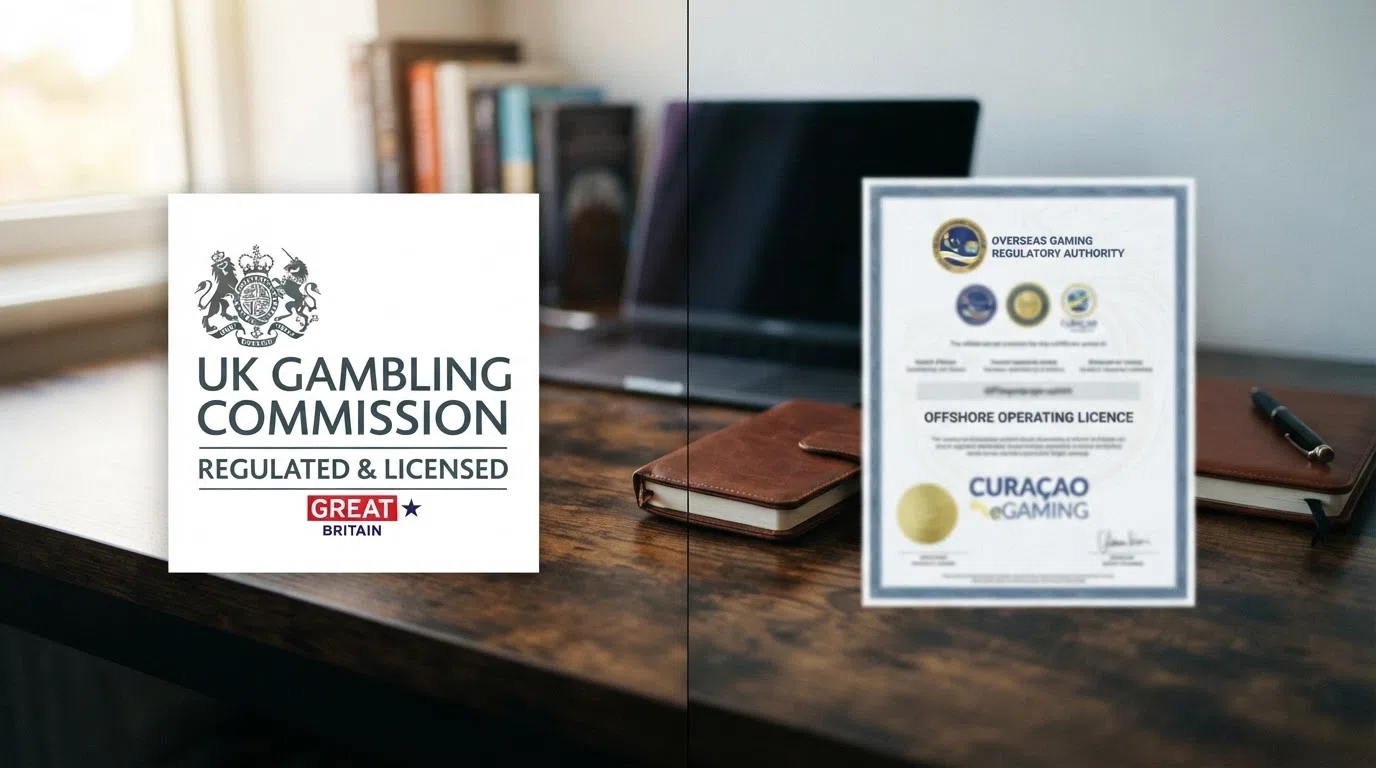
The legal exposure sits on the operator, not on the player. UKGC enforcement has historically focused on payment blocking and ISP-level disruption of offshore operators serving British customers. There is no record of UK players being prosecuted for using offshore sites; the practical exposure is the loss of UKGC recourse — no ADR process, no fund segregation, no Commission backstop — if a dispute arises. That is the trade-off the rest of this section breaks down.
The UKGC Rulebook: What It Caps and What It Bans
The table below sets the licensed-market rule beside what the offshore tier does instead. The UKGC column reads off the Commission’s published LCCP and RTS provisions; the offshore column reflects the typical behaviour of the ranking above.
| UKGC rule | Offshore (non-GamStop) reality |
|---|---|
| Slot stake capped at £5 (25+) or £2 (18–24) | No statutory stake cap; operator sets its own |
| Bonus wagering capped at 10x the bonus amount | Wagering commonly 20x to 60x; one operator at 10x, one at 0x |
| Cryptocurrency prohibited as a payment method | Crypto widely accepted; Bitcoin, Ethereum, USDT and others |
| Mandatory GamStop self-exclusion check at sign-up | No GamStop check; self-exclusion is per-site and optional |
| Vulnerability check at £150 net spend over 30 days | No equivalent; affordability checks are at the operator’s discretion |
| Bonuses may not mix product types (casino + sports) | Combined casino + sports bonuses common across the set |
| Marketing requires per-product, per-channel consent | No equivalent consent framework |
The rule that hits the player hardest is the wagering cap. The licensed multiple of 10x is roughly a third of what most offshore brands publish, and that gap is what the bonus-cost calculation later on the page is built around. The stake cap hits different players different ways; the crypto ban hits the players who would have used it; the GamStop condition is the one this entire page is built around.
Trust Markers That Separate a Real Licence from a Logo
Not every licence carries the same weight, and the gap between them is wider than the words suggest. At the top of the non-UK hierarchy sit the Malta Gaming Authority and the Gibraltar Gambling Commissioner — both run segregated client funds, both mandate Alternative Dispute Resolution processes, both publish compliance audit results. A Curaçao GCB licence is the baseline of the offshore tier; the 2024 to 2025 reform replaced the old master-licence structure with a per-operator OGL format that registers the operator’s name alongside the licence number. Anjouan, in force from April 2026 with its new Certificate Verification Framework, sits below Curaçao in the hierarchy — funds may not be segregated, and disputes are handled offshore. Costa Rica does not issue a gambling licence at all.
A logo on a footer is not a trust marker. A licence number that resolves on a regulator’s own register to the operator’s name is. That is the verification step the section on checking licences walks through.
Legal vs Legit: What Each Word Means for You
“Legal” and “legit” are two different words covering two different questions. “Legal” asks whether the operator is authorised to serve the British market under the Gambling Act 2005; the answer for the ranking above is no. “Legit” asks whether the operator pays out, segregates funds and treats players fairly on its own terms; the answer varies brand by brand and is established by the operator’s track record, not by statute.
A review site that calls an offshore casino “legal for UK players” is using “legal” in a loose sense — meaning not prosecuted against, or licensed somewhere — not in the Act’s sense. The honest framing is that the operator is unlicensed for the UK market, the player is not at legal risk, and the trust question is answered by the licence tier and the payout record rather than by a regulator’s word.
How to Verify an Offshore Licence in Five Minutes
The verification is mechanical and takes longer to describe than to run. The steps in order:
- Find the licence number on the casino’s terms or footer page. Curaçao GCB numbers carry the format OGL/YYYY/NNN/NNNN or the older 8048/JAZ format; Anjouan numbers carry the prefix ALN.
- Open the regulator’s public register. The Curaçao register sits on the Gaming Control Board’s site; Anjouan’s verification framework is the standard from 1 April 2026.
- Enter the licence number and confirm it resolves. The result should show the operator’s legal name, the licence status (active or otherwise), and the date of issue.
- Match the operator name on the register to the casino’s footer. A mismatch — Rolletto’s licence registered to a different legal entity, for example — is a flag worth following up.
- Cross-reference the operator group. Donbet, MyStake and Rolletto share the Santeda group, and a complaint against one is relevant to all three.
Five minutes well spent.
Why the Bonus Numbers Look Bigger — and Cost More
The headline percentages are large because the constraints that would hold them down are not in play. A UKGC licensee cannot run a 300% match with 35x wagering and 200 free spins — the wagering cap at 10x and the product-mixing rules would block most of that structure. An offshore operator can, and does.
The expected cost of clearing a bonus is what the headline does not show. Take Rolletto’s 150% up to £500: the required turnover on the bonus is £500 × 30 = £15,000, and at a slot RTP of 96.21% (the figure for Book of Dead, the most common slot the bonus clears against in this set), the statistical cost of clearing is £15,000 × (1 − 0.9621) = roughly £569 in expected loss. That is what the “free” bonus costs the player who clears it on slots alone. The £569 is an estimate — an average over thousands of spins under the assumption that only the bonus amount is wagered — not a guaranteed outcome for any single session.
The bonus’s real cost is what the calculation section on this page anchors to. The page reads better if the player reads it before the deposit, not after.
No-Deposit Offers: Free, but Never Free
The no-deposit offer is the entry step most of the offshore set publishes — a small bundle of free spins issued on registration, before any deposit is made. The wagering requirement on those spin winnings is the most expensive in the offer, because the player has already paid for the chance with zero deposit. The midpoint in the set is 35x, with a published range of 20x to 60x; below 25x is genuinely player-friendly and uncommon.
The cashout cap is the second catch. No-deposit free spins at offshore casinos typically carry a maximum cashout ceiling between £50 and £200. MyStake’s 30 no-deposit spins on Big Bass carry a £100 cap; the cashout ceiling is the difference between a small win and a withdrawn one. A player winning £300 on a 35x wager no-deposit offer sees £100, not £300, and the £200 is gone.
Free Spins: Welcome Packs and the Fine Print
The spin count is the headline; the per-spin terms are the substance. Rolletto’s 200 spins are issued 50 instantly and 30 per day across five daily logins — a drip that keeps the player returning. Velobet’s 70 spins carry 35x on winnings with a £100 cashout cap. Jack.com’s 100 spins carry 0x wagering and no win cap at all, which is why Jack.com sits where it does in the ranking.
The set splits cleanly into two camps. Most welcome spin packs charge a multiple on winnings — 30x or 35x, with a cashout cap between £50 and £200 — and the spin value is published (Velobet’s spins are issued at the deposit-staged value; Donbet’s no-deposit spins are fixed at 10p). Jack.com’s 0x wagering is the only true outlier. Reviewing these terms before committing remains the most effective protection against landing an offer that doesn’t fit your playstyle.
Wagering Terms: Why 30x Is Not What It Sounds Like
A 30x wagering requirement on a £500 bonus means £15,000 of qualifying bets before the bonus and its winnings become withdrawable. The “30x” sounds like a percentage; it is a multiplier applied to the bonus amount, not to the deposit. Where the rollover is on bonus funds alone, the player has the deposit in their pocket throughout. Where the rollover is on bonus plus deposit combined — as Donbet’s structure applies — the player is wagering through their own money as well.
The UKGC’s 10x cap is roughly a third of the typical offshore figure, and the cap is precisely why UKGC bonuses look smaller. The offshore brand is not absorbing the difference; the player is, in the form of a higher expected loss over a longer playthrough.
How to Compare One Offer Against Another
Headline percentage is the start of the comparison, not the end. Three other terms move the actual value: the wagering multiple, the cashout cap on free spins, and the validity window. A 300% up to £1,500 welcome at 35x with a £100 spin cap and a 30-day validity window is a different offer from a 300% up to £1,500 at 30x with no spin cap and a 14-day window, and the difference is in the player cost.
The expected loss calculation gives a single comparable number. Plug in the bonus amount, the wagering multiple and the RTP of the slot most players will use to clear, and the result is the statistical cost of clearing the bonus under those assumptions. Two offers at the same headline percentage can sit a hundred pounds apart on that number.
Loyalty and VIP: What Offshore Brands Actually Return
Loyalty programmes exist at most of the ranking’s operators; their terms are rarely published in detail. The VIP tier is a marketing label as often as it is a structure with stated benefits. The standard Rolletto pattern — a 10x win cap for standard players, lifted for VIP — is the most concrete published benefit; the entry route and the exact thresholds are not in the public terms.
The honest framing is that loyalty value at the offshore tier is opaque. Players who reach the VIP tier at Rolletto or similar brands generally do see the win cap lifted and cashouts prioritised; players who do not reach the tier see only the standard terms. Whether a player is likely to reach the tier depends on volume the operator does not publish.
The Payout Gap: Crypto in Minutes, GBP in Days
Crypto clears fastest, and the gap is wide enough to be the headline. Bitcoin, Ethereum, Litecoin and USDT withdrawals at offshore casinos typically process within minutes to a few hours; the same withdrawal at a UK-regulated casino takes one to three working days because of the banking rails and the verification friction. The set’s fastest-tested brand (Donbet, Velobet) clears crypto under an hour in normal conditions.
GBP withdrawals trail. E-wallets at most of the set clear in under 12 hours; debit cards take 48 to 72 hours; the average published payout for the Curaçao-licensed brands in the set is one to two days on a UK debit card rail. Jack.com publishes one to three hours for BTC; Winstler publishes zero to three business days across methods. Speed is method-specific, not brand-universal.
Depositing in Pounds: Methods That Work from the UK
GBP is accepted at every operator in the ranking. The rails vary. UK debit cards are the default and route through the usual card networks; the offshore operator’s payment processor is the friction, not the player’s bank. E-wallets (Skrill, Neteller, MuchBetter) clear in hours rather than days and are the mid-tier option for players who want to keep the bank statement clean. Crypto bypasses the bank entirely.
The minimum deposit at the set runs from £10 (MadCasino, MyStake, Donbet) to £25 (Slottio). Rolletto and Winstler both sit at £20. The minimum is what unlocks the welcome offer, and the difference between £10 and £25 is the difference between testing a brand and committing to it.
Real-Money Play: Minimum Deposits and What They Buy
A first deposit of £20 unlocks the welcome at most of the set. Rolletto and Winstler both sit at the £20 floor; MadCasino at £10; Slottio at £25. The minimum withdrawal is consistently higher than the minimum deposit — Winstler sets a £100 minimum withdrawal, which is unusually high and is worth knowing before the first deposit.
What the minimum buys is the bonus and the entry to the lobby. It does not buy the win — the wagering multiple and the cashout cap do the work of determining what comes back. A £20 deposit on a 300% welcome unlocks £60 of bonus funds and the wagering that goes with them; whether the player clears that bonus or walks away with the deposit is the entire game.
Fastest Payouts: What “Quick Withdrawal” Really Means
“Quick withdrawal” is a marketing phrase that means different things at different brands. At Donbet and Velobet, crypto clears in under an hour. At Jack.com, BTC clears in one to three hours. At the rest of the set, crypto under 24 hours is the published claim and the typical experience. E-wallets sit in the 12-hour window for most of the set. Debit cards sit at two to three days.
The brand marketing tends to overstate. A casino that advertises “instant payouts” is usually referring to the crypto rail and not to the debit-card one; a player expecting instant GBP withdrawals will be disappointed. The honest question is which method the player is using, not what the footer claims.
What Actually Delays a Withdrawal Offshore
Verification and limits, not the casino’s goodwill. KYC checks run the first time a player withdraws — the operator sends a documentation request, the player sends the documents, and the queue moves at the operator’s pace. Once verification is complete, the daily and weekly caps are the binding constraint: Winstler’s £1,000 daily and £2,000 weekly limits are the slowest in the set; the rest of the set either does not publish caps or sits at higher figures.
The order matters. A player who verifies at deposit rather than at first withdrawal gets through the queue faster; a player who deposits, plays, and only then sends their documents waits at the worst possible point. The withdrawal section of the operator’s terms is worth reading before the deposit, not after.
Slots and Live Tables: A Big Library, Uneven RTP
Depth is real across the ranking’s offshore set. The Curaçao-licensed brands carry slot libraries in the low thousands, drawing on the same provider stable the licensed market uses — Pragmatic Play, Play’n GO, NetEnt, Nolimit City, Evolution for live. UK-specific differences are minor; the same titles are available, the same providers supply them, and the same jackpots sit at the top of the lobby.
RTP varies by title, and the figures are uneven. Research carries RTP for three titles — Book of Dead, Big Bass Bonanza and Starburst — and a partial volatility class for two of them. The rest of the lobby is opaque at the title level: an RTP range is published by the provider but not by the operator, and the live RTP at any given brand is the operator’s choice within that range.
British-Themed Slots and the Titles Players Actually Spin
| Slot | Provider | RTP | Volatility | Max win |
|---|---|---|---|---|
| Book of Dead | Play’n GO | 96.21% | High | 5,000x |
| Big Bass Bonanza | Pragmatic Play / Reel Kingdom | 96.71% | Medium-high | 2,100x |
| Starburst | NetEnt | 96.09% | Low | 500x |
Three titles is not a representative sample, and the table does not pretend to be one. Book of Dead is the slot the bonus wagering most often clears against, and the 96.21% figure is what the expected-loss calculation on this page is anchored to. Big Bass Bonanza is the title most of the set’s no-deposit spins attach to. Starburst is the legacy low-volatility anchor that shows up in older welcome packages.
Game Variety: How Deep the Offshore Lobby Runs
The lobby at the typical Curaçao-licensed brand runs from slots at the top through table games and live dealer to a jackpot section at the bottom. Provider diversity is broad — Pragmatic Play and Play’n GO dominate, with Evolution handling live dealer across most of the set. Nolimit City, Hacksaw Gaming and ELK Studios show up on the high-volatility end. A player used to a UKGC lobby will recognise the structure and the providers; the differences are at the title level rather than the genre level.
Real-Money Slots vs Free Play: What Changes
Demo mode is available across most of the set and is the default landing mode for slots at several of the brands. The RTP in demo mode is the same as in real-money mode at the same operator, but the volatility is identical and the win distribution is identical. What changes between demo and real money is the player’s relationship to the loss — a £500 spin in demo is a click; a £500 spin in real money is the rent.
The honest framing is that demo mode is useful for learning a title and useless for testing what an operator pays. Payout testing requires real money, a real deposit, and a real withdrawal — the kind of test only a player with a stake can run.
Live Dealer Tables: Studios, Streams and UK Hours
Live dealer reach for UK players is good. Evolution runs the studios for most of the set; Pragmatic Play Live covers the rest. UK hours are no obstacle — live tables run 24/7 from the studio locations, and the stream quality holds up across both wifi and mobile data. The set offers live blackjack, live roulette, live baccarat and the game-show formats (Crazy Time, Monopoly Live, Sweet Bonanza Candyland) that have grown fastest in the last three years.
Sterling stakes are the friction point. Some live tables at offshore operators run in EUR only; the player deposits in GBP and the table converts at the operator’s rate. A player who plans to play live regularly should check the table’s currency before sitting down.
Progressive Jackpots and the Big-Win Chasers
Progressive jackpots are the headline of every lobby and the lowest-RTP segment of the slot library. The published max-win figures on the researched titles — 5,000x on Book of Dead, 2,100x on Big Bass Bonanza — sit well below the network progressives (Mega Moolah, the Age of the Gods series) that carry seven-figure pools. The jackpot RTP is lower than the base-game RTP because a slice of every spin funds the pool; a player chasing the headline is paying for the chance with a smaller statistical return.
The honest framing is that jackpots are entertainment products, not investment products. The max-win figure is the ceiling; the RTP is the floor; the gap between them is the operator’s margin and the jackpot funder’s contribution.
Mobile Play: Browser-First and Fewer Apps
Offshore play runs in the browser. Every casino in the ranking is reachable through a mobile browser without an install, and most of them are not reachable any other way. The reason is partly regulatory — app-store restrictions on real-money gambling apps in the UK are narrow — and partly commercial: a responsive site costs less to maintain than a native app and works across iOS, Android and the rest.
The practical upshot is that a smartphone is a complete casino. The same lobby, the same bonuses, the same live tables; the differences from desktop are in screen size and battery, not in access.
The Apps Worth Installing: A Short Offshore List
Few offshore brands ship a native app. The set in this ranking does not include any operator that publishes a downloadable iOS or Android app through the standard stores; the few apps that exist in the offshore space are distributed as direct downloads from the operator’s site. That distribution model is itself a friction — a player installing an app from a non-store source accepts the source’s word on what the app does.
For a player who wants an app, the browser is the answer for most of the set. The exception, where it exists, is a Web App shortcut — a bookmark on the home screen that launches the casino in full-screen mode. That is not an app, but it behaves like one.
Browser vs App: What Offshore Casinos Prefer
The browser is the product, and the operator’s incentive is to keep it there. A native app costs more to build and maintain across iOS and Android, costs more to update, and triggers app-store review friction on every release. A responsive site costs less and reaches every device the player owns.
Data use on mobile networks is the player-side consideration. A live dealer table in HD consumes data at a rate a desktop user does not think about; on a capped mobile plan, a long session is a real cost. A player who plays primarily on mobile should plan for the data.
Phone and Tablet Play: What to Expect in Practice
The full library fits a phone screen. The lobbies are responsive; the slots render in portrait and landscape; the live tables scale to the device. Touch play is the input model across the set, and the slot UX is built for thumbs — the spin button is bottom-centre, the bet adjuster is a single tap away, the autoplay is set up for a one-handed session.
Battery and data are the costs. A long live dealer session on a phone is the heaviest use case; a slot session in portrait is the lightest. A player who plans to play live on mobile should plan for both.
New Launches in 2026: Fresh Faces, Unproven Records
The offshore set turns over quickly. New brands appear every quarter, often on the same operator-group scaffolding as established ones. The published launch year is sometimes the year the brand was named; sometimes it is the year the underlying operator group got its licence. The two are not the same.
Age is a trust proxy, not a guarantee. A five-year-old brand has a payout record; a six-month-old brand has a marketing budget. The check on either is the same — licence, payout history, terms — but the weight to put on the answer differs.
The Latest Launches: What Is Actually New
Donbet launched in 2023 under Santeda International B.V., the same group behind MyStake (in market since 2020) and Rolletto. The brand is new; the operator is not. The Curaçao licence OGL/2024/250/0115 was issued on 1 July 2024, more than a year after the brand’s launch — the gap is worth noting because a brand operating without a current licence is a different risk profile from one operating under a fresh one.
Newness is often a rebrand. The Santeda group pattern — MyStake first, Rolletto alongside, Donbet as the most recent — is common in the offshore tier, and a player who has played one brand in the group has effectively played the others for risk-assessment purposes.
How to Vet a Casino That Opened This Year
The five checks apply harder to a new brand. The licence number is the same check; the licence number on a fresh brand is harder to verify because the regulator’s register may not yet reflect the issuance. The Anjouan Certificate Verification Framework, effective from 1 April 2026, is the new standard for how a player confirms an Anjouan licence is current; the framework was published in response to a surge in Anjouan-licensed brands that turned over faster than the regulator could track.
Payout evidence on a new brand is the hardest check. There is no record; the forums are thin; the review aggregators are catching up. A player who cannot find any third-party payout evidence on a brand less than a year old should treat that absence as information.
New vs Established: What You Trade Either Way
Established brands have records; new ones have promos. MyStake at five years and Freshbet at six have a payout history that is searchable and a complaint pattern that is readable. Winstler at three and Donbet at two have a marketing budget that the established brands do not need. The trade-off is between track record and incentive.
A player who wants the bigger welcome is choosing from the new end of the set. A player who wants the longer track record is choosing from the established end. Neither is the objectively correct answer; both are reasonable trades the player should make deliberately.
The Support Net That Still Catches UK Players
Playing outside GamStop does not remove the help. The UK support services — GamCare, BeGambleAware, the National Gambling Support Network — are reachable regardless of where a player plays. GamStop itself remains the right route for any player who has registered and is now looking to play at an offshore site; the offshore tier will not stop them, but the player’s own self-exclusion commitment is a different kind of stop, and one that matters.
The support infrastructure is real and under pressure. Around 0.5% of the adult English population experience problem gambling, with another 3.8% at elevated risk; an estimated 7% of the British population are negatively affected by someone else’s gambling. The GamCare National Gambling Helpline made 996 referrals to treatment in January 2026 — a 48% increase year-on-year. The volume is up; the resource is there.
GamStop and Self-Exclusion: How the Scheme Works
GamStop is the national online self-exclusion scheme, mandatory for every UKGC-licensed operator. The registration is at gamstop.co.uk and runs for a chosen period of six months, one year or five years. Five-year exclusions remain the most popular at 47% of registrants. Registrations from young adults aged 16 to 24 rose 40% year-on-year in the second half of 2025; that age group accounted for 29% of all new registrations.
A registered player using an offshore casino is making a choice the scheme cannot block. The scheme’s reach ends at UKGC licensees; the player is the only remaining line of defence, and the support lines in the section below are the practical tools for holding it.
Deposit Limits and Session Controls at Offshore Sites
Offshore controls are optional, not mandatory. A deposit cap, a session timer, a self-exclusion button on the site — these are features some operators in the set build and others do not. The £150 vulnerability check that triggers a conversation at a UKGC site has no equivalent offshore; the operator may run affordability checks at its discretion, but there is no statutory threshold.
A player who wants the controls should choose an operator that publishes them and set them at the deposit. The default at the offshore tier is no controls at all.
Where UK Players Get Help: Numbers and Lines
The support lines are concrete and reachable:
- GamCare National Gambling Helpline: 0808 8020 133, open 24 hours a day, every day. Web chat and self-help tools at gamcare.org.uk.
- BeGambleAware: free advice, tools and support for anyone affected by gambling, at begambleaware.org.
- National Gambling Support Network: a GambleAware-commissioned network providing treatment and support across Great Britain.
The evidence is clear: when people can access support, self-exclusion and practical tools together, they are significantly more likely to reduce their gambling and sustain that change over time. The infrastructure exists; using it is the choice that matters.
How We Reviewed and Ranked
The ranking above is built on five inputs, each of which is reproducible. The licence column is built from the public registers of the Curaçao Gaming Control Board and the Anjouan Betting & Gaming Board, with verification against the Anjouan Certificate Verification Framework effective 1 April 2026. The bonus column reads off each operator’s own published welcome terms at the time of research. The wagering column is the multiple stated in those same terms. GBP acceptance is verified against the cashier. The verdict on each operator is the editor’s, drawn from the four data points above and the operator’s track record where one exists.
The ranking is ordered by the editor’s assessment of which brand fits which player profile, with the no-wagering offer at Jack.com and the lowest wagering multiple at Slottio as the clearest fits for the cost-conscious player, the largest headline at Freshbet and the longest track record at MyStake as the fits for the welcome-chasing player, and the Curaçao GCB cluster as the regulatory baseline against which the weaker Anjouan and Costa Rica positions are read. None of the operators on the UK list are UKGC-licensed, and that distinction matters more than most casino review sites let on.
What to Actually Do Before You Play Outside GamStop
Read the licence column before the bonus column. A 600% headline at an Anjouan-licensed brand with a £1,000 daily withdrawal cap is a different proposition from a 150% headline at a Curaçao brand with a track record; the percentage is the least informative part of either. The verification step from earlier in the page — register lookup, operator name match, group cross-reference — is five minutes that change the rest of the session.
Price the bonus against the expected loss. Rolletto’s £500 bonus at 30x wagering on a 96.21% RTP slot costs roughly £569 in statistical expectation. That is what the bonus really costs the player who clears it; the £500 is what the player keeps if they walk away before the wagering completes. Two bonuses at the same percentage can sit £200 apart on that number, and the difference is the wagering multiple and the cashout cap.
Keep the help line to hand. The GamCare number — 0808 8020 133 — is open 24/7. The honest framing is that the offshore tier does not run affordability checks on the player’s behalf, and the player who finds themselves playing longer or larger than they planned is the player who needs the line. Putting it in the phone before the first deposit is the move that matters.
The arithmetic on the page is a statistical estimate, not a guarantee — an average over many spins under the stated assumptions. It promises no win, no payout and no return. What it does promise is a clearer picture of what the offer costs the player who takes it, and what the alternative at a UKGC-licensed site costs the player who does not. The choice between them is the reader’s, and the rest of the page is built to make it informed.
Frequently Asked Questions About Non-GamStop Casinos
Can I self-exclude from a non-GamStop casino after joining?
Each offshore operator runs its own self-exclusion process through its own responsible-gaming tools. A player who has self-excluded via GamStop remains blocked at every UKGC-licensed site; that block does not extend to the offshore tier. Self-exclusion at an individual offshore casino is per-site and lasts for the period the operator sets in its own terms.
How do offshore wagering terms (20x–60x) compare with the UKGC 10x cap?
The UKGC’s 10x cap is roughly a third of the typical offshore multiple. Offshore wagering on no-deposit free spins commonly runs 20x to 60x, with the midpoint around 35x. Bonus-fund wagering at offshore sites is typically 30x to 35x. One operator in this ranking — Slottio — publishes 10x, and one — Jack.com — publishes 0x on its spin offer.
Which withdrawal method clears fastest at these casinos?
Crypto clears fastest. Bitcoin, Ethereum, Litecoin and USDT withdrawals at offshore casinos typically process within minutes to a few hours; Donbet and Velobet both publish under an hour in testing. E-wallets sit at under 12 hours. UK debit cards sit at 48 to 72 hours. Speed is method-specific, not brand-universal, and the brand marketing tends to overstate.
How do I actually check an offshore licence is genuine?
Find the licence number on the operator’s terms or footer page, open the regulator’s public register, enter the number, confirm the operator’s legal name matches the casino’s footer, and cross-reference any operator group. The Anjouan Certificate Verification Framework, effective from 1 April 2026, is the current standard for Anjouan checks; the Curaçao GCB public register handles Curaçao lookups. The full walk-through is in the verification section above.
Why do offshore welcome offers look so much larger than UKGC ones?
UKGC rules cap bonus wagering at 10x the bonus amount and ban mixing product types within a single bonus. Offshore operators are not bound by either rule, and the larger headline reflects the looser structure — a 300% match with 35x wagering and 200 free spins is possible offshore and impossible under UKGC rules. The expected cost to the player of clearing that bonus is correspondingly higher.
Can I deposit and play in pounds sterling at these sites?
Yes. Every operator in this ranking accepts GBP. UK debit cards are the default deposit method; e-wallets and crypto are widely accepted. The minimum deposit runs from £10 to £25 across the set. GBP withdrawals route through the same methods, with e-wallets clearing in hours and debit cards in 48 to 72 hours.
Account – Casinos That Accept Bitcoin UK
Content created by the «Casinos That Accept Bitcoin UK» team