
Where UK Players Find Bigger Bonuses and What That Costs Them
 Available in GB
A foreign casino, for a UK player, is any operator that takes deposits from customers in Great Britain without holding a Gambling Commission licence. The category is unified by that single regulatory fact. The brands below differ in almost everything else: welcome match percentages from 100% to 300%, free-spin allocations from 30 to 500, game libraries from 4,000 to over 10,000 titles, and Curaçao or Costa Rica licences sitting underneath. The verification work — bonus terms, wagering requirements, licence jurisdiction, the GB register check — is laid out operator by operator. So is the cost of clearing the bonus in spins and in hours, and the protection package a UK player walks away from by signing up to any of them. The arithmetic lands where the marketing does not: a 300% headline match at 35× wagering is a different proposition from a 100% match at the same multiple, and a player comparing offers needs to see both.

Verified as of 16 August 2026 against the UKGC public register, HMRC published guidance and GamCare annual data.
More Than Just a Casino Abroad: What “Foreign” Really Means for UK Players in 2026
A “foreign casino” for a UK player is any operator that accepts deposits from customers in Great Britain without holding a UK Gambling Commission licence. The label says almost nothing about where the company is incorporated, what currency it uses, or which regulator it answers to. What it does say is unambiguous: the site is outside the UKGC’s day-to-day regulatory perimeter, and the protection package that comes with a GB operating licence does not apply.
The line is drawn by the Gambling (Licensing and Advertising) Act 2014, which extended an existing requirement so that any operator providing gambling facilities to customers in Great Britain must hold a UKGC licence — wherever the operator is based. A Curaçao eGaming permit, a Malta Gaming Authority authorisation, or a Gibraltar Gambling Commissioner licence are recognised licences in their own jurisdictions, but each one is not a substitute for a GB operating licence when the brand accepts deposits from UK customers. That asymmetry is the spine of every other distinction on this page.
Three consequences fall out of the line. First, none of the brands ranked below appear on the UKGC public register, which listed 2,663 business records as of late July 2026 and is the verification source for every GB licence claim in this article. Second, GAMSTOP, the UK’s national self-exclusion scheme, is mandatory on every Gambling Commission online operating licence since 31 March 2020 and sits on that same licensing boundary, so a player excluded via GAMSTOP is not protected at any of these brands. Third, the Commission’s enforcement work targets operators, advertisers and intermediaries; no UK player has been prosecuted for using an offshore casino, and every sanction traced under section 33 of the Gambling Act 2005 hits the commercial side.
That is what makes the category coherent. The brand names below share one property — they accept UK players without a GB licence. They differ in almost everything else.
The Terminology: Foreign, Offshore, Non-UK, International — What Each Label Actually Means
UK players searching this niche encounter a small pile of overlapping labels. “Foreign casino”, “offshore casino”, “non-UK casino” and “international casino” are used interchangeably across affiliate sites; in practice they describe the same population — operators licensed outside Great Britain that accept UK customers.
“Non-GamStop casino” is the one label that signals something more specific. It names an operator that is also outside the GAMSTOP self-exclusion network, which is true of every foreign casino by definition, and is sometimes used by operators as a marketing badge. The label tells you what the site is not, not what licence it holds.
The terms that carry regulatory meaning are the licence names themselves: Curaçao eGaming, the older Curaçao master-licence format, Malta Gaming Authority, Anjouan, Costa Rica, Kahnawake. Where research confirms a specific licence, this article names it. Where a licence could not be confirmed from the sources reviewed, that gap is left visible rather than guessed around.
Why UK Players Look Beyond the UKGC: Bonuses, Freedom, and the GamStop Factor
Three drivers push UK players toward foreign casinos, and they line up with three pieces of UKGC regulation that the offshore market does not replicate.
Bonus size and structure is the most visible. From 19 December 2025, wagering requirements at GB-licensed operators are capped at 10× under the Licence Conditions and Codes of Practice, and mixed-product promotional offers have been banned. The foreign casinos ranked below carry wagering requirements of 30× to 40× on the bonus, which sounds worse on its face but arrives with headline match percentages of 150% to 300% and free-spin allocations in the hundreds. The arithmetic is in the calculation further down this page.
The gameplay environment is the second pull. Online slots at GB-licensed sites carry a statutory maximum stake per game cycle — £5 for players aged 25 and over, in force from 9 April 2025, and £2 for players aged 18 to 24, in force from 21 May 2025, both imposed by SI 2025/215. A foreign casino is under no such constraint; the operator sets its own stake ceiling, often several times higher than the GB cap. Several other UKGC rules — the auto-play ban, the 2.5-second minimum spin speed, the prohibition on features that speed up play, the reverse-withdrawal ban — are similarly GB-only and do not apply offshore.
Payment friction is the third driver. The UK banned credit cards for all gambling in April 2020, but the offshore market accepts cards, e-wallets and a wide range of cryptocurrencies. Some UK players find the absence of GamStop itself a draw — players who have self-excluded and reached the end of an exclusion period, or who registered under one identity and now use another, are outside the GB exclusion network when they move offshore. The section on self-exclusion covers why that gap is treated as a protection gap rather than as a feature.
The Jurisdictional Picture: Where These Casinos Are Actually Based
Curaçao dominates the offshore market serving UK players. Nine of the ten brands ranked below hold a Curaçao licence — either the older master-licence format (5536/JAZ, the master licence under which Winstler operates through Favorit United N.V., launched October 2022) or a Curaçao eGaming sub-licence of the kind held by MyStake (8048/JAZ2020-013, Santeda International B.V., operating since 2020). The remaining brand, Winorio, operates under a Costa Rica licence through AXENTRA LTD, having launched in March 2025.
What a Curaçao licence does and does not require is the part most guides skim over. A Curaçao licence confers a right to operate in the issuing jurisdiction, mandates anti-money-laundering checks and provides an arbitration route through the Curaçao Gaming Control Board. It does not require a UK-equivalent player protection framework: no mandated GAMSTOP equivalent, no affordability-check architecture, no mandatory deposit-limit prompt, no Commission complaints route. Enforcement depth and player-redress mechanisms are materially lighter than a UKGC operating licence, and the gap shows up in the next major section of this article.
The ownership picture matters because licence transitions are live news in this niche. NEXT.io reported in 2026 that the group behind MyStake — also the owner of Velobet, Donbet and GoldenBet — was moving its brands to a new offshore licence after a period of scrutiny, with sites previously licensed through Santeda International B.V. in Curaçao. Players choosing between these brands should know the licence behind the brand may change during the life of their account.
The Best Foreign Casinos Accepting UK Players in 2026
The table below compares the ten highest-profile foreign casinos that accept UK players on the headline terms that drive a first-time sign-up: licence jurisdiction, welcome match percentage and cap, wagering multiple and free-spin allocation. Detailed terms — minimum deposit, maximum bet while wagering, validity window — follow operator by operator underneath. None of these brands appears on the UK Gambling Commission’s public register; every one is unlicensed in the GB market and outside the GAMSTOP network.
| Operator | Licence | Welcome Bonus | Wagering | Free Spins |
|---|---|---|---|---|
| GoldenBet | Curaçao | 300% up to £1,500 (across 3 deposits) | 35× (deposit + bonus) | 100 |
| Freshbet | Curaçao | 300% up to £3,000 (across 3 deposits) | 40× (welcome bonus) | 200 |
| Rolletto | Curaçao | Up to £5,500 (across 3 deposits) | 30× (bonus amount) | 200 |
| MyStake | Curaçao (8048/JAZ2020-013) | 170% up to £1,500 | 30× (deposit + bonus) | 30 |
| Donbet | Curaçao | 150% up to £750 | 30× (deposit + bonus) | 50 |
| Velobet | Curaçao | 150% up to £500 (casino track) | 30× (bonus) | 70 |
| Winorio | Costa Rica | 100% up to €500 (first deposit) | 40× (slots) / 20× (live casino) | 150 |
| Kaasino | Unconfirmed | 100% up to £2,500 (across 4 deposits) | 40× | 500 |
| Jackbit | Curaçao | Wager-free welcome offer | 0× | — |
| Winstler | Curaçao (5536/JAZ) | Headline match (exact figure not confirmed) | — | — |
These ten brands share the regulatory position. The differences lie in the offer, the catalogue and the licence structure behind each brand.
GoldenBet: 300% Across Three Deposits — the Biggest Headline Match Percentage
GoldenBet’s headline number is the highest match percentage in the set: 300% across the first three deposits, taking the total bonus ceiling to £1,500, plus 100 free spins. The wagering is 35× on deposit and bonus combined, the minimum deposit is £20 and the maximum bet while a bonus is active is £5 per spin. Curaçao-licensed.
The 300% match is what catches the eye; the 35× wagering on deposit and bonus combined is what determines whether the offer is worth taking. At the maximum, a £500 first deposit carries a £1,500 bonus and a turnover requirement of 35 × £2,000 = £70,000, run at the £5-per-spin ceiling. That figure is the entry ticket to the 100 free spins. GoldenBet suits a player who has decided the bigger welcome is worth the heavier turnover and who reads the bonus terms before the first deposit — and who is comfortable that the brand sits in the same ownership group as MyStake, Velobet and Donbet, with the NEXT.io-reported licence transition live in the background.
Freshbet: 300% to £3,000 + 200 Free Spins With 5,500 Games
Freshbet is the second 300% match in the set, but with a higher cash ceiling — £3,000 across three deposits — and a heavier free-spin allocation, 200 spins. The wagering on the welcome bonus is 40×, the high end of the set. Curaçao-licensed.
Where Freshbet stands out is the catalogue: 5,500 games, with Push Gaming, Hacksaw Gaming and Pragmatic Play confirmed in the offer. That is the widest confirmed game library among the brands for which a figure is available, and the only confirmation in this ranking that those three specific studios are present. For a player who has a shortlist of titles or studios, Freshbet is the brand on this list where those studios are confirmed available; the 40× wagering is a tradeoff to access that library.
Rolletto: The Biggest Headline Package — Up to £5,500 + 200 Free Spins
Rolletto carries the largest total bonus figure in the set: up to £5,500 plus 200 free spins, spread across the first three deposits. The wagering is 30× on the bonus amount — lower than Freshbet and GoldenBet, but on a larger base. The maximum bet while a bonus is active is £5, the validity is 30 days, and the catalogue runs to 4,000+ titles across 84 game providers. Curaçao-licensed.
The structure favours a player who deposits larger amounts in the first three transactions and wants the longest validity window in the set. The 30-day clock is meaningful: at the £5-per-spin ceiling and 30× on bonus only, clearing the maximum offer requires roughly 33,000 spins, which is 30 days of consistent play with no margin for a missed day. Rolletto is a player who commits the time, not a player who plays casually between deposits.
MyStake: 170% to £1,500 + 30 Free Spins — the Highest Single-Deposit Match
MyStake is the highest single-deposit match percentage in the set at 170%, capped at £1,500, plus 30 free spins. The wagering is 30× on deposit and bonus combined, the minimum deposit is £20 and the maximum bet while a bonus is active is £5 per spin. The validity is 30 days. MyStake operates under Curaçao eGaming licence 8048/JAZ2020-013, is owned by Santeda International B.V. and has operated since 2020.
NEXT.io reported that the group behind MyStake — also the owner of Velobet, Donbet and GoldenBet — was moving its brands to a new offshore licence after a period of scrutiny. Players considering MyStake should expect the licence behind the brand to be in motion during the life of their account. The 170% single-deposit structure suits a player who wants the whole bonus in one transaction rather than across three, and who is comfortable with a Curaçao sub-licence that may be in transition. The calculation further down runs the arithmetic on this offer as the worked example.
Donbet: 150% to £750 + 50 Free Spins — Straightforward Terms, Same Group
Donbet’s offer is the cleanest in the Santeda group: 150% up to £750 plus 50 free spins, with 30× wagering on deposit and bonus combined, £20 minimum deposit and a £5 maximum bet while a bonus is active. Curaçao-licensed. The smaller cap and the lower free-spin count sit against a wagering multiple that matches MyStake’s; the trade is fewer spins in exchange for a smaller total bonus to clear.
For a player who wants the simplest possible terms from this group, Donbet is the cleaner read. The same NEXT.io licence-transition context applies: this is part of the same ownership group as MyStake, Velobet and GoldenBet, and the licence behind the brand may change. A player who values transparency of terms above bonus size lands here.
Velobet: Multi-Track Welcome — Casino, Crypto, and Sports Paths
Velobet is the only operator in the set with separate welcome tracks for casino, crypto and sports, each with its own wagering multiple. The casino track runs 150% up to £500 plus 70 free spins at 30× wagering on the bonus; the crypto track runs 160% up to €1,000 at 35× wagering; the sports track runs at 15× wagering. Free-spin winnings carry an additional 35× wagering with a £100 maximum cashout. The catalogue lists 80+ software providers. Curaçao-licensed.
The split structure is unusual in the set: a player choosing a track can match the wagering multiple to the product they actually intend to play. The £100 maximum cashout on free-spin winnings is the soft cap to watch; even a long free-spin run ends at £100 of withdrawable winnings, regardless of headline allocation. Velobet provides a single-account answer for those who would otherwise split their play across different platforms, though the licence-transition context of the wider Santeda group remains a factor.
Winorio: The Newest Entrant — 10,000+ Titles and the Only Costa Rica Licence
Winorio is the newest brand in the ranking, launched in March 2025 under a Costa Rica licence operated by AXENTRA LTD — the only Costa Rica-licensed entry in the set. The welcome package is 100% up to €500 plus 150 free spins on the first deposit, with 40× wagering on slots and a notably lower 20× on live casino. The minimum deposit is €20 (or £20), and the bonus carries a 5-day validity timer. The catalogue lists over 10,000 titles, the largest game library in the ranking.
The split wagering is the structural feature: a player who intends to play live casino pays half the wagering multiple of a slots-only player, and the 5-day validity timer is the tightest in the set. For a player who wants the largest game library and is comfortable clearing the bonus in five days rather than thirty, Winorio is the outlier. For a player who needs a longer clearance window, the same offer elsewhere has more time. The Costa Rica licence is the second divergence — recognised in its own jurisdiction, but a less common jurisdiction than Curaçao in this niche.
Kaasino: 100% to £2,500 + 500 Free Spins Across Four Deposits
Kaasino’s standout number is the free-spin allocation: 500 spins, the largest in the set, paired with a 100% match up to £2,500 across four deposits. The wagering is 40× and the minimum deposit is £30 — higher than every other entry in the ranking. Progressive jackpots are noted in the offer.
The licence jurisdiction for Kaasino could not be confirmed from the sources reviewed. The brand is not on the UKGC public register, and no offshore licence could be verified from the materials available. That is the material caveat on this entry. For a player who values the largest free-spin allocation in the ranking and the four-deposit structure, Kaasino is the offer; for a player who weighs licence visibility above offer size, this operator may fall short.
Jackbit: The Only Wager-Free Welcome Offer in the Set
Jackbit is the structural outlier. The welcome offer is wager-free — 0× wagering — and the brand is positioned as crypto-native. Curaçao-licensed. Detailed supplementary terms, such as minimum deposit and bonus validity, are not specified for this offer, with the wager-free status being the primary feature.
The wager-free structure is the single biggest difference between Jackbit and every other brand on this list: winnings from the welcome offer are withdrawable without a turnover requirement. The trade is the absence of the larger headline match percentages — a player who values the simplicity of zero wagering pays for it in a smaller bonus headline. For a player who has been put off by 30× to 40× wagering on previous welcome offers, Jackbit is the structural alternative. The gap on supplementary terms is the cost of reading this offer against the others on the page.
Winstler: Curaçao Master Licence 5536/JAZ — an Established Operator Entity
Winstler operates under Curaçao master licence 5536/JAZ, held by Favorit United N.V., and has been trading since October 2022. The headline welcome match is frequently described as among the largest in the offshore market.
The licence is the entry’s verifiable feature: a Curaçao master licence is a recognised framework, the operator entity has been trading since late 2022, and the brand is established in this niche. For a player who ranks operator longevity and a named licence above headline bonus size, Winstler is the verifiable entry in this list. The gap on the welcome figure is the cost of reading this brand against the others on the page.
More Games, Fewer Rules: What Offshore Casinos Offer That UKGC Sites Cannot
The provider landscape at foreign casinos overlaps heavily with the GB-licensed market. Pragmatic Play, Evolution Gaming, NetEnt and Play’n GO all appear across the featured set; Freshbet confirms Push Gaming, Hacksaw Gaming and Pragmatic Play by name; Rolletto lists 84 providers and over 4,000 titles; Velobet names 80+ providers; Winorio tops the set with 10,000+ titles. A UK player leaving the UKGC framework is not leaving these studios behind.
What the UKGC framework does not travel with is the rulebook those studios work under inside Great Britain. Game-design rules that bind GB-licensed operators do not bind offshore sites: auto-play is not banned offshore; the 2.5-second minimum spin speed does not apply; features that speed up play are not prohibited; losses disguised as wins are not classified as a banned design pattern; and reverse withdrawals are not permanently disabled. The same slots run faster, autoplay is available, and a player can change their mind on a pending withdrawal — each a feature a GB site cannot offer after 31 October 2021.
The catalogue difference is upstream of the rulebook difference. UKGC-restricted games remain available at offshore sites, which is why a foreign casino can list 4,000 to 10,000+ titles while a GB-licensed operator typically runs a smaller library after restricted mechanics are removed. This increased selection is the primary benefit of the offshore model.
The Same Providers, a Wider Catalogue: What You Can Actually Play
The studio names that anchor a UK casino lobby all appear in offshore lobbies. Pragmatic Play’s slots and Drops & Wins tournaments are widely available; Evolution Gaming’s live dealer suite is the same product at both ends of the licensing boundary; NetEnt and Play’n GO are present across most of the featured set. Freshbet is the only operator in the ranking that confirms Push Gaming, Hacksaw Gaming and Pragmatic Play by name — a useful marker for a player with a shortlist of studios.
The count is where the difference becomes visible. Rolletto lists 84 providers and over 4,000 titles; Freshbet lists 5,500 games; Winorio lists over 10,000 titles; Velobet names 80+ providers. A typical GB-licensed casino runs a smaller curated catalogue after UKGC-restricted mechanics are removed, so the headline game count at an offshore site is not just a marketing figure — it reflects a wider pool of available product.
The practical limit on that catalogue is the player’s own shortlist: a wider library still comes down to the few hundred titles a player actually returns to. The wider catalogue is the visible benefit; the slot-level experience is similar to the GB-licensed equivalent where the same studios are present.
Offshore Slots vs UKGC Slots: What the Rulebook Changes
UKGC game-design rules — in force from 31 October 2021 — are the regulatory frame a UK player leaves behind. Auto-play is banned; the spin speed carries a 2.5-second minimum; features that speed up play are banned; losses disguised as wins are banned; reverse withdrawals are permanently disabled; session losses, wins and time played must be displayed. None of these rules apply at an offshore site, because none of them are written into a Curaçao or Costa Rica licence.
The stake limit is the rule that hits the bankroll directly. Online slots at GB-licensed operators carry a statutory maximum stake of £5 per game cycle for players aged 25 and over, and £2 per game cycle for players aged 18 to 24 — both imposed by SI 2025/215, in force from April and May 2025 respectively. An offshore site sets its own ceiling, often several times higher, which lets a player place larger individual bets and clear wagering requirements faster — but which also removes the regulator-set guardrail on stake size.
The wagering cap is the symmetric change on the offer side. From 19 December 2025, wagering requirements at GB-licensed operators are capped at 10× and mixed-product promotional offers are banned. The foreign casinos ranked here carry 30× to 40× wagering on the welcome bonus, and several offer multi-product welcome packages. The bonus term at an offshore site is structurally heavier; the underlying game runs with fewer restrictions.
The wagering cap and the stake cap pull in opposite directions: more turnover required, but faster clearing possible. Whether the trade favours the player depends on the specifics of the bonus and the time the player can put in. The calculation in the next section runs the arithmetic on a single example.
The Legal Reality: No, You Will Not Be Prosecuted — But Here Is What You Lose
UK players face no legal risk for playing at a foreign casino. The point bears repeating because the search-result snippets on this subject are uneven about it. The Gambling Act 2005 regulates domestic operators; the 2014 Act extends the licensing requirement to any operator serving GB customers. The criminal offence under section 33 is committed by the operator serving GB customers without a licence, not by the player who uses the site. No UK player has been prosecuted for using an offshore casino; every sanction traced under section 33 targets operators, advertisers and intermediaries. PremiumTimesNG’s coverage of this niche states the position plainly: “The Gambling Act 2005 regulates domestic operators, not individual punters. You won’t face penalties for playing overseas slots or table games at a licensed offshore platform.”
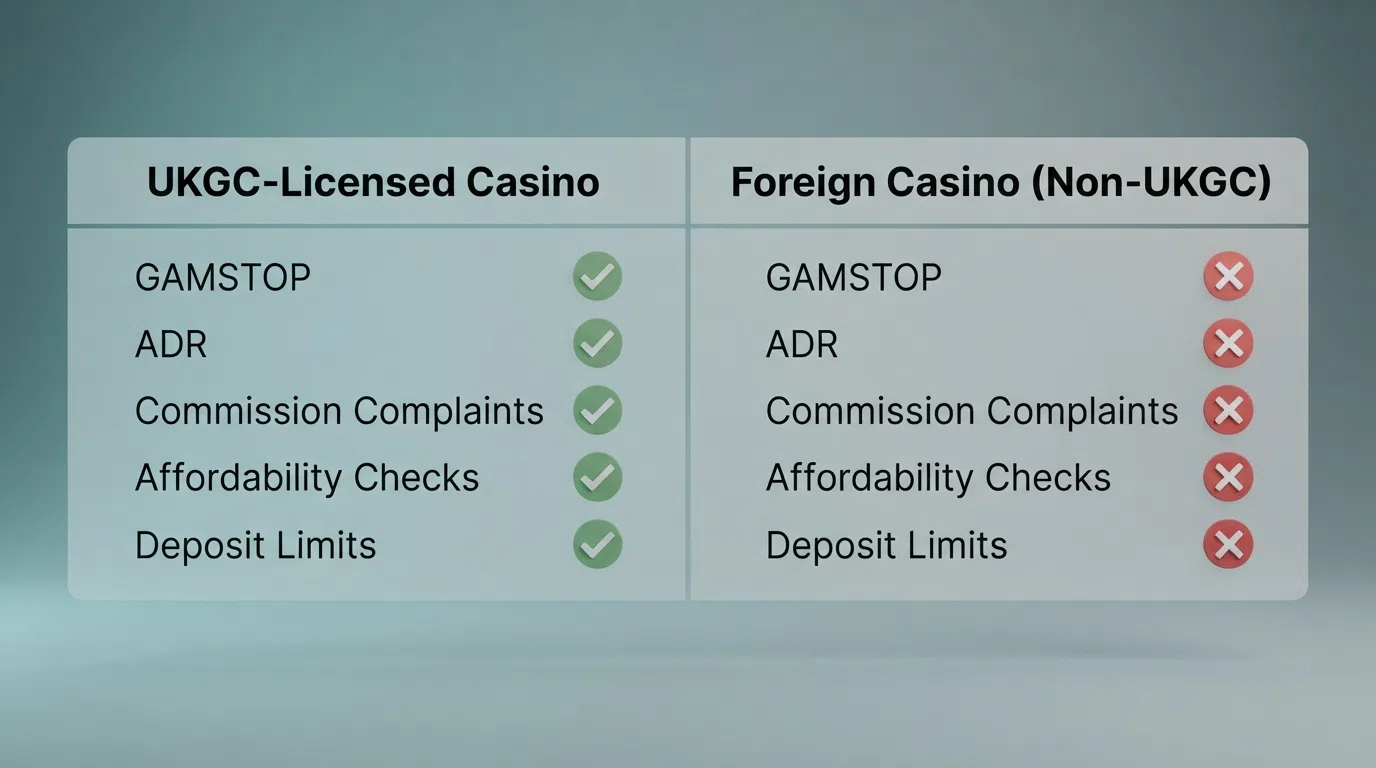
What the player does face is the absence of the UKGC protection package that comes with a GB operating licence. The table below sets out every major player protection a GB-licensed casino must provide and what a foreign casino outside the UKGC framework actually delivers.
| Player Protection | UKGC-Licensed Casino | Foreign Casino (Non-UKGC) |
|---|---|---|
| GAMSTOP self-exclusion | Mandatory on every online operating licence since 31 March 2020 | Not covered — the operator is outside the GB licensing system |
| Commission complaints route | Available via UKGC public register and ADR | Not available — no UKGC complaints process |
| Alternative Dispute Resolution (ADR) | Required under LCCP | Not required; redress is via the offshore licence’s own arbitration |
| Financial vulnerability checks at £150 net deposit (rolling 30 days) | Required from 28 February 2025 | Not required — no mandated affordability architecture |
| Mandatory deposit-limit prompt before first deposit | Required from 31 October 2025 | Not required |
| Gross deposit limit offered | Required (date extended to 30 September 2026) | Not required |
| Reverse withdrawals | Permanently banned since October 2021 | Allowed — operator discretion |
| Auto-play ban, 2.5-second minimum spin speed, no speed-up features | In force from 31 October 2021 | None of these apply offshore |
| Statutory stake cap on online slots (£5 for 25+, £2 for 18–24) | In force from April/May 2025 | Not applicable — operator sets its own stake ceiling |
| Wagering requirement cap at 10× | In force from 19 December 2025 | No equivalent cap; welcome bonuses commonly carry 30×–40× |
| Credit card ban for gambling | In force since 14 April 2020 | Not applicable |
The legal position for the player is settled; the practical position is that the player opts out of every entry in the right-hand column by signing up.
The Gambling Act 2005 and the Point-of-Consumption Framework
The Gambling Act 2005 set the licensing objectives that frame everything the UKGC does — preventing crime, ensuring fairness and openness, and protecting children and vulnerable persons. The Gambling (Licensing and Advertising) Act 2014 is the amendment that draws the line for foreign operators: any operator providing gambling facilities to customers in Great Britain must hold a UKGC licence, wherever the operator is based. A Curaçao, Maltese or Gibraltar licence is not a substitute when GB customers are being served.
The point-of-consumption framework is what makes that line enforceable. The Commission does not need to show that an operator is based in the UK to take action — it needs to show that the operator is serving GB customers. Section 33 of the Gambling Act 2005 carries the criminal sanction: up to 51 weeks’ imprisonment, an unlimited fine, or both, for operating without a GB licence. Every sanction the Commission has issued under this section has been aimed at the commercial side; no UK player has been prosecuted for using a foreign casino.
The regulatory boundary does not stop being sharp because no player has been prosecuted. The boundary is sharp because the sanctions exist and the enforcement programme uses them — cease-and-desist notices with 48-hour deadlines, search-engine delisting referrals, payment-provider pressure, and the disruption figures detailed in the enforcement section below. The player is not in the Commission’s enforcement perimeter; the operator is.
The UKGC Protection Package: What You Leave Behind at a Foreign Casino
The protection package that comes with a GB operating licence is an interconnected architecture, and the offshore market replicates none of it.
GAMSTOP — the UK’s national self-exclusion scheme — is mandatory on every Gambling Commission online operating licence since 31 March 2020. It is the cross-operator safety net a player can use to block themselves from every GB-licensed site for six months, one year, five years, or five years with auto-renewal. Because GAMSTOP sits on the GB licensing boundary, it does not reach offshore sites. A player who has self-excluded via GAMSTOP and is not at the end of their exclusion period is, in practice, opting out of the cross-operator safety net by signing up offshore.
Financial vulnerability checks came in from 28 February 2025 under LCCP Social Responsibility Code 3.4.4 — a light-touch check using public data when a customer crosses a £150 net deposit threshold in a rolling 30-day period. More detailed affordability assessments have been announced but not yet commenced; Stage 1 thresholds would be £5,000 net deposits in 24 hours for players aged 25 and over and £2,500 for players under 25. None of these checks are mandated at an offshore site.
Deposit limits come in two parts at GB-licensed sites. From 31 October 2025, operators must prompt the customer to set a financial limit before first deposit. A gross deposit limit must be offered (originally due 30 June 2026, extended to 30 September 2026). A decrease must be actioned immediately; an increase need not be. None of this is required offshore.
Game-design and payment rules complete the architecture. Auto-play has been banned at GB sites since 31 October 2021, with the 2.5-second minimum spin speed and the prohibition on features that speed up play; losses disguised as wins are banned; reverse withdrawals are permanently disabled; credit cards have been banned for all gambling in GB since 14 April 2020. None of these rules travel with the player to an offshore site.
The asymmetry is not a marketing detail. Every entry in the right-hand column of the table earlier in this section is a regulator-mandated protection at a GB site. At an offshore site, the protection that exists is whatever the operator has chosen to offer.
Tax Treatment: HMRC’s Position on Overseas Casino Winnings
UK players owe no tax on gambling winnings from any jurisdiction. Player-side betting duty was abolished in 2001, and the burden moved wholly to operators. HMRC’s published position is unambiguous, confirmed via its Community Forum: “From a UK point of view, there would be no UK tax liability” on winnings from a non-UK licensed online casino. The position applies to Curaçao-licensed sites, Costa Rica-licensed sites and any other offshore operator; the operator’s licence jurisdiction is irrelevant to the player’s tax position.
What has changed is the operator-side duty. Remote Gaming Duty — the duty on operator profits from online casino — rose from 21% to 40% with effect from 1 April 2026, applying to accounting periods beginning on or after that date. The statutory gambling levy, which replaced voluntary contributions, commenced in April 2025 under the Gambling Levy Regulations 2025 and sits at 1.1% of gross gambling yield for remote casino licences, with proceeds split 50% treatment, 30% prevention and 20% research. Both are operator costs. Neither creates a liability for the player.
The player-side tax position is therefore the same regardless of which casino a UK player uses: no income tax, no capital gains tax, no separate gambling duty on the player. The only place a UK player might pay tax on gambling winnings is on professional gambling income treated as a trade, which is a separate regime and not affected by the operator’s licence jurisdiction.
How the UKGC Enforces Against Unlicensed Operators
The Commission’s enforcement strategy against unlicensed operators is disruption-based, not blocking-based. The UKGC does not currently hold statutory ISP or DNS blocking powers — legislation has been proposed but not enacted — so its tools are cease-and-desist notices with 48-hour deadlines, search-engine delisting referrals, domain registrar and hosting provider pressure, and payment-provider referrals.
The figures for the period April 2024 to June 2025 give a sense of scale: 3,140 disruption notices issued, 447,778 URLs referred to search engines for delisting, 287,961 URLs removed, and an average 32% fall in engagement across 160 disrupted sites. Each individual measure is incremental — a delisting is not a block, a 48-hour notice is not a seizure — but the cumulative effect is a meaningful reduction in the discoverability and reach of unlicensed operators serving GB customers.
Section 33 of the Gambling Act 2005 is the criminal sanction that sits behind the disruption work: up to 51 weeks’ imprisonment, an unlimited fine, or both, for operating without a GB licence. The sanction is aimed at operators, advertisers and intermediaries; the player is not within its reach. The architecture is the same logic as the legal-position section above: regulator pressure on the commercial side, no criminal liability on the player side.
Staying Safe When the UKGC Safety Net Is Not There
The UKGC framework does not reach offshore sites, but the help infrastructure for UK players with gambling problems does. GamCare’s National Gambling Helpline is available 24/7 on 0808 8020 133 regardless of where a player gambles; the NHS operates 15 specialist gambling treatment clinics across England; bank-level gambling transaction blocks work independently of both GAMSTOP and the operator. The protection gap created by leaving the UKGC perimeter is real, and so are the tools that work around it.

The arithmetic of a foreign casino bonus is the clearest illustration of what the protection gap costs the player in concrete terms. Using MyStake’s published offer as the worked example — bonus up to £1,500, 30× wagering on deposit and bonus combined, £5 maximum bet per spin while a bonus is active — required turnover comes to £1,500 multiplied by the 30× wagering factor, which is £45,000, and at the £5-per-spin ceiling that means 9,000 spins, running 12.5 hours of continuous play at a five-second interval, assuming only the bonus amount is wagered. Because the wagering applies to deposit and bonus combined rather than bonus alone, the actual turnover requirement rises once the qualifying deposit is included: roughly £71,500 in turnover, around 14,300 spins and close to 25 minutes of continuous play to clear the offer at the maximum match. Both are statistical estimates averaged over many spins under the stated assumptions, not guaranteed outcomes for any single session — they promise no win, no payout and no return.
Responsible-Gambling Tools at Foreign Casinos: What to Look For
Some foreign casinos offer deposit limits, session timers, reality checks and operator-level self-exclusion — but each of these is voluntary at the operator level rather than mandated by a regulator. A player signing up to an offshore site should expect to check what is actually offered in the account settings before depositing, because the answer varies brand by brand and the regulator behind the brand is not going to require it.
The contrast with the GB-licensed market is the structural point. From 31 October 2025, GB-licensed operators must prompt the customer to set a financial limit before first deposit; a gross deposit limit must be offered (date extended to 30 September 2026); reality checks must be displayed during play; session losses, wins and time played must be shown. None of these prompts is required at an offshore site. A player who relied on the GB-licensed deposit-limit prompt to set their own boundary needs to set that boundary manually at an offshore site — and the offshore site has no obligation to remind them to do so.
The minimum standard a player should look for before depositing at any foreign casino: a working deposit limit in the account settings, a session timer or reality check, a clear self-exclusion route, and a published complaints or contact address. If a brand does not offer any of these, that is information the player should weigh against the bonus headline.
Self-Exclusion Without GamStop: What Actually Works
GAMSTOP’s coverage boundary is the practical problem, as set out in the protection-package section above. The boundary is that GAMSTOP only covers GB-licensed sites, so an excluded British player is not protected at any of the brands ranked on this page.
Three tools work around the gap. Operator-by-operator self-exclusion is the most direct: a player can self-exclude at each offshore brand individually, and the brand will block the account for the chosen period. It is a patchwork rather than a cross-operator safety net — a player who uses multiple offshore brands needs to set up the exclusion at each one — but it works at the operator level.
Bank-level gambling transaction blocks are the second tool. Major UK banks — Lloyds, Barclays, HSBC, NatWest, Monzo and Starling — offer gambling transaction blocks that operate at the card level and work independently of both GAMSTOP and any operator system. The block stops card payments to betting merchants regardless of the casino’s licence, so a player who has a gambling block set at their bank cannot fund an offshore casino account from that bank. This is the closest thing to a GAMSTOP-equivalent for offshore sites, and it is available without any registration with the casino itself.
The third tool is the simplest: do not deposit. A player who has self-excluded via GAMSTOP and continues to feel the pull toward gambling has the option not to sign up at an offshore site. The bank block is the safety net if that resolution slips; the operator-level exclusion is the secondary layer.
Where UK Players Can Get Help: Helplines, Clinics, and Practical Steps
The UK has one of the most developed gambling-harm treatment infrastructures in the world, and every part of it is available regardless of where a player gambles. GamCare’s National Gambling Helpline (0808 8020 133) is available 24 hours a day, 7 days a week, by phone and online chat. In 2024/25, the helpline received over 130,000 calls and online messages, made 7,100 referrals into further treatment, delivered 8,100 treatment sessions and held an average wait time of 1.3 days.
The NHS operates 15 specialist gambling treatment clinics across England, with seven opened in the year to December 2024. NHS gambling referrals totalled 4,355 in 2024/25 — up from 2,284 in 2023/24, more than a doubling year on year. The treatment is free at the point of use.
Prevalence context comes from the NHS Adult Psychiatric Morbidity Survey 2023/24: 1.6% of adults experienced at least moderate risk gambling (PGSI 3+) and 0.4% experienced problem gambling (PGSI 8+). These are the population-level numbers behind the help-line demand; they are also the numbers behind the protection gap, because every offshore site serving UK players sits outside the framework designed to support that population.
A further marker of unmet demand: 30% of adults who gamble and experience problems want treatment or support — up from 17% in 2020, according to GambleAware and YouGov. The treatment infrastructure is growing; the demand for it is growing faster. For a player using any of the brands on this list and finding that use has become harder to control, GamCare, GambleAware, the NHS clinics, and Gamblers Anonymous are all reachable from the UK without reference to where the gambling takes place.
How We Evaluated These Foreign Casinos
The ranking above is built from operator sites, affiliate reviews from the main review sites covering this niche, the UK Gambling Commission’s public register for licence verification, HMRC public guidance for tax position, and GamCare and NHS data for the responsible-gambling framework. Where research confirms a specific figure — a wagering multiple, a free-spin count, a licence number — that figure is on the page. Where the figure could not be confirmed from the sources reviewed, the gap is left visible rather than guessed around; the entries for Kaasino (licence jurisdiction), Jackbit (supplementary bonus terms) and Winstler (exact welcome figure) carry that acknowledgement.
The verification of GB licence status is the most consequential check. The UKGC public register (last updated 29 July 2026, 2,663 business records) is the source of truth for whether an operator holds a GB operating licence. None of the ten brands ranked on this page appear on that register. Every one of them is unlicensed for the GB market and outside the GAMSTOP network. That is the structural property that defines the category and that the verification work was designed to confirm.
The ranking identifies the highest-profile brands in the foreign-casino niche that accept UK players, on the criteria that drive a first-time sign-up: bonus terms and wagering, licence jurisdiction, game library scale, operator track record and transparency of terms. The ranking is not a recommendation and does not endorse unlicensed operators. This page describes what each brand offers and what each one costs; it does not direct the reader to a particular brand.
The same verification work was applied to the legal and regulatory claims on this page. The Gambling Act 2005 and the 2014 Act’s point-of-consumption framework are standing law. The 10× wagering cap, the £5 and £2 stake caps, the reverse-withdrawal ban, the credit card ban and the GAMSTOP mandate are all sourced to the relevant UKGC and GOV.UK publications. The figures for UKGC enforcement against unlicensed operators (April 2024 to June 2025) come from the Commission’s published data. The tax position is HMRC’s published position. Where a regulator-side change is in force, the date is carried with it; where a regulator-side change has been announced but not commenced, that distinction is kept.
What All of This Means for Your Next Casino Session
The trade-off is real, and it runs in both directions. Bigger welcome bonuses and fewer gameplay restrictions on the offshore side; an entire UKGC protection architecture — GAMSTOP, ADR, Commission complaints, financial vulnerability checks, deposit-limit mandates, the stake cap — on the GB-licensed side. A player signing up to any of the brands above opts out of every entry in the right-hand column of the comparison table earlier in this article. They do so as a private individual; the law does not sanction them for it. The regulator behind the brand is lighter, and the safety net is correspondingly thinner.
The arithmetic on the bonus side, run on MyStake’s published offer as the worked example, lands at roughly £45,000 of turnover, 9,000 spins at the £5 ceiling and 12.5 hours of continuous play to clear the bonus alone — longer once the qualifying deposit is included. The same clearance at a GB-licensed operator would carry a 10× wagering cap, a £5 spin ceiling, an affordability check at the £150 threshold, and a deposit-limit prompt that the offshore site does not have to offer. The bonus headline and the protection package move together: heavier bonus terms sit on the same side of the trade as lighter protections.
What a player can still use is straightforward. Bank-level gambling blocks at Lloyds, Barclays, HSBC, NatWest, Monzo and Starling work independently of GAMSTOP and any operator. Operator-level self-exclusion is available at the brand itself. GamCare’s helpline (0808 8020 133) and the NHS gambling treatment clinics are available regardless of where a player gambles. The protection gap is real; the workarounds are real too.
Neither choice is cost-free. A GB-licensed casino caps wagering at 10× and stakes at £5, but it also requires identity checks, blocks self-excluded players from returning, and operates inside a stricter bonus structure. A foreign casino offers 150% to 300% match percentages with 30× to 40× wagering, a wider catalogue and crypto-friendly banking, and it does so outside every protection in that list. The honest verdict at the end of this ranking is that the offshore market offers things the UKGC-regulated market does not, and it costs things the UKGC-regulated market does not charge. Knowing what each one costs is the point of reading this far.
Frequently Asked Questions
Is it legal for UK players to use foreign online casinos?
Yes. The Gambling Act 2005 regulates domestic operators, not individual punters. The criminal offence under section 33 is committed by the operator serving GB customers without a UKGC licence, not by the player who uses the site. No UK player has been prosecuted for using an offshore casino. Every sanction traced under the Act targets operators, advertisers and intermediaries.
Do I pay tax on winnings from non-UK casino sites?
No. UK players owe no tax on gambling winnings from any jurisdiction. Player-side betting duty was abolished in 2001, and HMRC’s position is that there is no UK tax liability on winnings from a non-UK licensed online casino. The operator’s licence jurisdiction is irrelevant to the player’s tax position; only professional gambling income treated as a trade is taxed.
Are foreign casinos connected to GamStop?
No. GAMSTOP is mandatory on every UK Gambling Commission online operating licence since 31 March 2020, but it sits on the GB licensing boundary and does not reach operators outside the GB licensing system. Every brand on this list is outside GAMSTOP’s coverage, which is the structural reason the “non-GamStop” label is used to market them.
How do bank-level gambling blocks work if GamStop does not cover offshore sites?
Bank-level blocks operate at the card payment level, not at the operator level. Lloyds, Barclays, HSBC, NatWest, Monzo and Starling all offer gambling transaction blocks that stop card payments to betting merchants regardless of the casino’s licence. A player who has a gambling block set at their bank cannot fund an offshore casino account from that bank, with no registration with the casino needed.
What licences do offshore casinos that accept UK players typically hold?
Curaçao eGaming dominates — either the older master-licence format or sub-licences like the one MyStake holds (8048/JAZ2020-013). Winorio is the Costa Rica outlier in this set through AXENTRA LTD. A Curaçao licence is recognised in its own jurisdiction but is not a substitute for a UKGC licence when GB customers are being served.
What are the risks of playing at Curaçao-licensed casinos from the UK?
The structural risks are the absence of the UKGC protection package — no GAMSTOP coverage, no Commission complaints route, no mandated affordability checks, no deposit-limit prompt, no ADR. Enforcement depth is lighter than a UKGC operating licence. The legal position for the player is settled, but the practical position is that the player sits outside every entry in that protection list.
Can I set deposit limits at foreign casinos that are not UKGC-regulated?
Some foreign casinos offer deposit limits, session timers and operator-level self-exclusion, but each is voluntary at the operator level rather than regulator-mandated. A player should check what is offered in account settings before depositing, because the answer varies brand by brand. Bank-level gambling blocks and operator-level self-exclusion are the practical alternatives that work independently of any deposit-limit tool the casino may offer.
Licence – Casinos That Accept Bitcoin UK
Content created by the «Casinos That Accept Bitcoin UK» team