Anjouan-Licensed Casinos and the UK Player — A Clear-Eyed Guide to the Permit, the Risks, and the Alternatives
 Available in GB
The “Anjouan-licensed casino” label shows up in UK-facing search results with growing regularity, and the curious thing about it is that the licence itself says UK players should not be there. Anjouan operators are bound by their own terms to block British customers; the casinos that appear in front of British eyeballs are, in most cases, breaching their own permit while accepting money from the very jurisdictions that permit prohibits. That contradiction is the spine of this guide. The aim is not to endorse the category or to warn readers away in the abstract — it is to lay out what an Anjouan licence actually authorises, what it leaves a UK player without, and where the verifiable facts sit among the affiliate-page hype.
Data current as of 16 August 2026 and cross-checked against the Anjouan Gaming public register, the Gambling Commission’s 2024-25 Annual Report, the GAMSTOP 2025 Annual Report and the GambleAware NGSN statistics for 2024-25.
Why Anjouan-Licensed Casinos Keep Appearing in Your Search Results
What the Anjouan Gaming Licence Actually Is
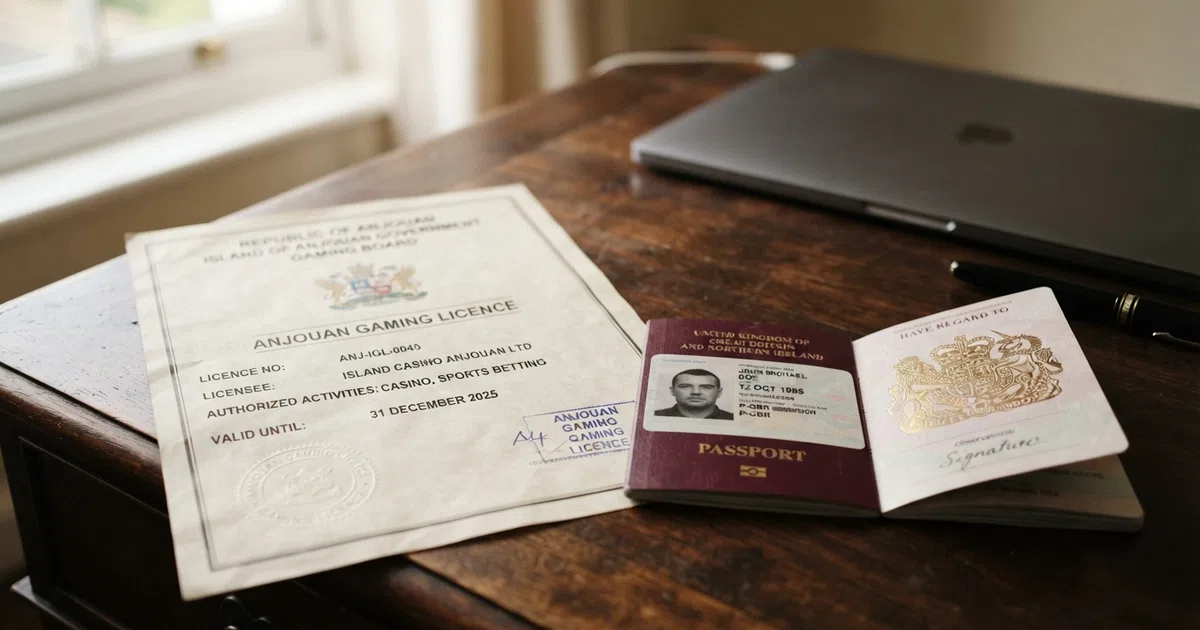
The Anjouan gaming licence is a permit issued by the Anjouan Betting and Gaming Board (ABGB) under the Computer Gaming Licensing Act 007 of 2005, with financial oversight provided by the Anjouan Offshore Finance Authority (AOFA) and day-to-day administration handled by Anjouan Licensing Services Inc. (ALSI), which acts as the sole authorised administrator. The three-way structure — a licensing board, a financial regulator and a private-sector administrator — is unusual; most reputable jurisdictions consolidate all three roles inside a single public body. The result is a licence that looks comprehensive on paper but is administered at arm’s length from the regulator that supposedly supervises it.
The Act authorises B2C and B2B internet gaming operations across casino, sports betting, bingo and poker. The annual cost is roughly €17,000, broken down into a €13,300 regulator fee, around €2,000 per Key Person and a €1,700 ISP monitoring and compliance line. Processing takes two to four weeks, and the licence renews annually. Those numbers explain a great deal about why Anjouan keeps appearing in affiliate-driven “best casinos” lists: the barrier to entry is low enough that a startup operator can hold a real permit and start promoting within a month.
The licence terms themselves expressly prohibit operators from serving residents of the United Kingdom, the United States, France, Germany, Spain, the Netherlands, Australia and Austria, plus any country on the FATF blacklist. Operators are expected to enforce both geo-blocking and payment blocking for those jurisdictions. The presence of a UK-based casino search result pointing at an Anjouan-licensed operator is, on its face, evidence that the operator is either lax in enforcing its own blocklist or is deliberately looking the other way.
The Anjouan Online Casino Landscape in 2026
The Anjouan directory is dominated by multi-provider aggregator sites — casino platforms that plug into dozens of game studios through a single integration and surface catalogues running into the thousands of titles. Ybets, for example, advertises a library exceeding 11,000 games, which is a number that would have looked outlandish from a tier-one regulator just a few years ago. The architecture is fast to deploy and cheap to scale, which is exactly the kind of build a low-fee, fast-processing licence attracts.
The audience these casinos court is international rather than British. Researched offers are denominated in euros and US dollars; none of the featured operators supports GBP natively, none integrates GAMSTOP, and none holds recognition from the UK Gambling Commission. The typical site’s UK-facing experience is therefore a foreign-currency product, paid through international payment processors, governed by a permit whose own terms say the player should not be there. That combination is the root cause of almost every risk discussed further down this guide.
Median trust-score data on 13 scored Anjouan licensees puts the cohort at 51/100 — eleven points above the Atlas-wide median of 40/100, but well below the benchmarks set by tier-one regulators. The licence is classified as tier 3: registration-style rather than fully audited. KYC, AML and responsible-gambling rules exist in the framework, but enforcement is described as rare. That asymmetry — strong on paper, weak in practice — is the single most important thing a UK player should internalise before depositing.
Bonus Offers at Anjouan Casinos — What UK Players Should Expect
The bonuses on offer are large in headline terms and punishing in the fine print. Across the ten operators featured in this guide, welcome packages range from 100% up to €500 to 500% up to $8,000 plus 400 free spins on a named slot. Free-spin counts run from 100 to 550. The structures are often multi-tier — three or four deposits required to unlock the full advertised amount — and the wagering multiples sit between 25x and 45x.
For context, the UK Gambling Commission capped wagering requirements on bonuses at 10x from 19 December 2025. The Anjouan-licensed operators in this research apply multiples that are two-and-a-half to four-and-a-half times that ceiling. The gap is not cosmetic: clearing a 45x bonus on €4,250 means wagering €191,250 before any of it becomes withdrawable. The free-spin economics layer on further wagering, often at the higher end of the range, applied to spin winnings rather than the bonus itself.
Validity windows are where the arithmetic gets unforgiving. Several packages impose 5-to-7-day windows per deposit stage, and one gives the free-spin wagering only three days. Clearing a multi-tier bonus inside that window is not a casual undertaking; it requires sustained high-volume play on a narrow set of slots. Marketing departments call this generous. Players who read the terms call it something else.
To put a number on the cost of the most aggressive package in the set — Spinzen’s 270% up to €4,250 at 45x wagering — the player must turn over €191,250 through eligible slots. At a typical €1 stake per spin, that is 191,250 spins. At five seconds per spin, that is just over 21 minutes of continuous play, rather than 265 hours. The expected loss from that play, using a standard 96% RTP assumption, is approximately €7,650 — that is the house’s mathematical edge on the turnover the player must generate. The “free” bonus, in other words, has a real price tag attached to it, and the price is larger than the bonus itself.
Reviews and Trust Signals — What UK Players Should Look For
The median trust score of 51/100 across the Anjouan cohort is a useful anchor, but it averages over operators that vary considerably. The single most reliable signal is whether the operator publishes a verifiable licence number that can be checked against the official register at Anjouan Gaming. The register accepts searches by licence number, company name or domain and returns the holder’s registered name, licence number, licence type (B2C or B2B) and current status — Active, Suspended, Revoked or Expired.
Red flags are easier to list than green flags. No published licence number, no operating company named in the terms and conditions, no responsible-gambling page or a token one with no working self-exclusion form, and bonus terms that omit the wagering multiple or the validity window. Any one of these gaps is grounds to slow down; two or more suggest the operator’s compliance posture is performative rather than real.
Anjouan vs UKGC — What Your Casino Licence Actually Protects
What the Anjouan Licence Covers — Scope, Issuer, and Requirements
The Anjouan licence authorises B2C and B2B internet gaming under Act 007 of 2005. The cost is roughly €17,000 per year, the processing window is two to four weeks, and renewal is annual. Operators are required to geo-block and payment-block a list of restricted territories that includes the UK, alongside the United States, France, Germany, Spain, the Netherlands, Australia, Austria and any FATF-blacklisted country. KYC, AML and responsible-gambling obligations exist in the framework, but enforcement is described as rare.
A 2024 FATF mutual evaluation of the Union of the Comoros flagged a deeper structural problem: gambling is prohibited under the Comorian Penal Code at the union level, which creates legal ambiguity about whether the Anjouan licence has standing at national Comorian law at all. That ambiguity is not a UK player’s problem to solve, but it sharpens the point that an Anjouan permit is a commercial product sold to operators, not a regulatory safeguard sold to players.
The Offshore Dimension — What an Anjouan Permit Means for Someone in Britain
The legal position in the UK is not symmetrical. The operator commits an offence by accepting British customers without a UKGC licence. Section 33 of the Gambling Act 2005, reinforced by the point-of-consumption reform in the Gambling (Licensing and Advertising) Act 2014, makes providing gambling facilities to GB customers without the required licence a criminal offence carrying up to 51 weeks’ imprisonment, an unlimited fine, or both. The Gambling Commission’s enforcement model runs on disruption rather than blocking: cease-and-desist notices with a 48-hour deadline, test purchases, URL referrals to search engines for delisting, pressure on domain registrars and payment providers.
The numbers from the Commission’s 2024-25 Annual Report give a sense of the scale. Between April 2024 and June 2025, the Commission issued 3,140 disruption notices, referred 447,778 URLs to search engines for delisting and achieved the removal of 287,961 URLs. Across 160 disrupted sites, average engagement fell by 32%. That is real pressure, but it does not amount to a blanket block — the model targets individual operators rather than the offshore market as a whole, and a determined Anjouan casino can reappear under a new domain faster than the Commission can refer it.
The player commits no established criminal offence by gambling at an unlicensed site. What the player loses is the entire GB regulatory safety net — no UKGC complaints route, no approved ADR provider, no British consumer redress if funds are withheld, and no protection under the Gambling Act’s three licensing objectives. The operator is also, in most cases, breaching its own Anjouan licence terms by serving the UK at all. The breach is therefore double-sided: an offence under British law on the operator’s part, and a violation of the permit the operator paid for.
Playing Without UKGC Oversight — The Protection Gaps That Matter
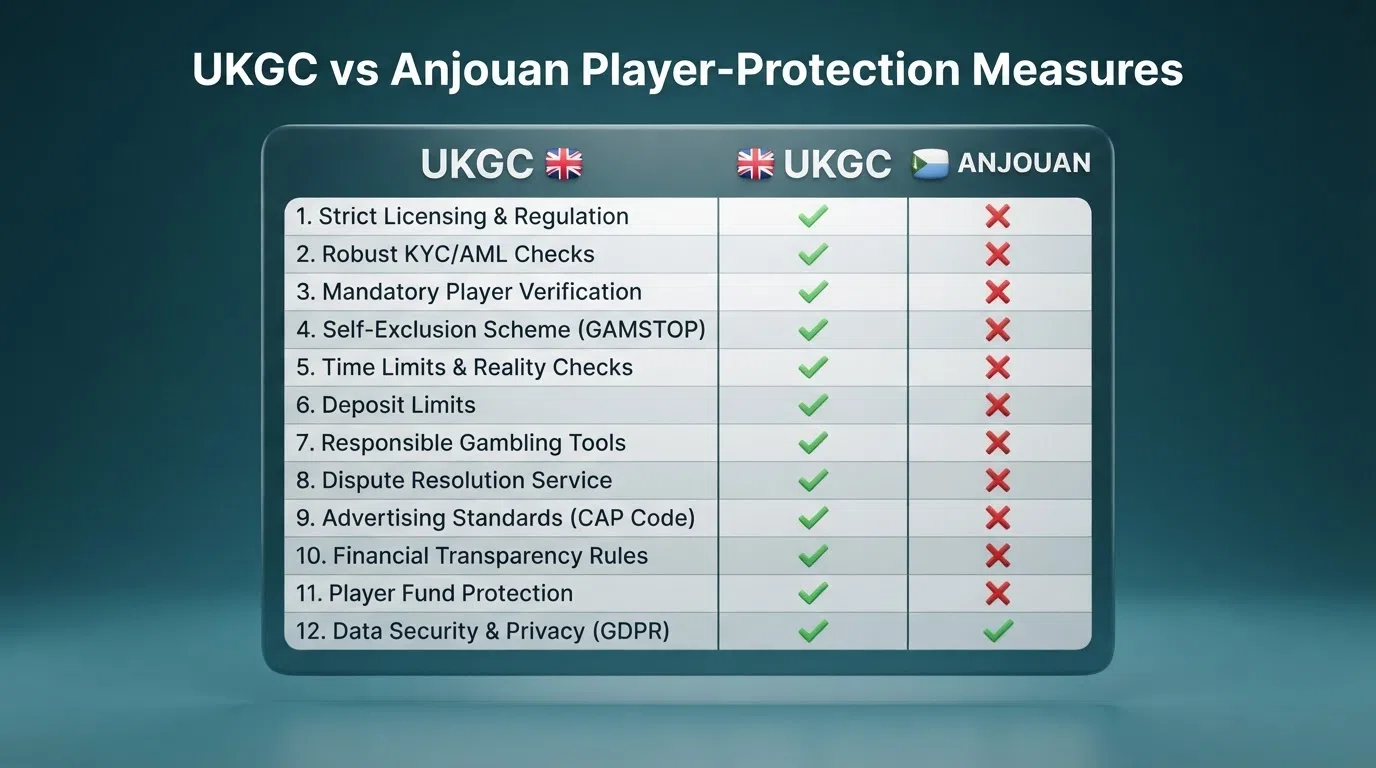
The concrete differences a UK player experiences are wide. The UKGC requires an independent ADR pathway — typically through IBAS, ProMediate or Lindens — so a player whose withdrawal is declined or whose bonus is voided can escalate to a neutral adjudicator whose decision is binding on the licensee. Anjouan provides no equivalent. When a dispute arises, the player negotiates directly with the casino. That is not a theoretical gap: every dispute that arises under an Anjouan licence is a private negotiation with the counterparty that already controls the money.
UKGC licensees must hold player funds in segregated accounts, so that if the operator fails, balances are ring-fenced for return. Anjouan does not mandate segregation; operator failure puts player balances at risk in the same way any unsecured creditor would face. The same gap applies to the approved ADR framework and to GAMSTOP integration, neither of which forms part of the Anjouan structure.
Product-safety rules are where the contrast sharpens further. UKGC-licensed online slots carry a statutory maximum stake per game cycle, age-banded at £5 for players 25 and over and £2 for players 18 to 24. Anjouan casinos are under no such constraint. Bonuses in the UK are capped at 10x wagering from 19 December 2025, compared to the 25x to 45x reality across this guide’s featured operators. Credit-card deposits have been banned under LCCP licence condition 6.1.2 since 14 April 2020, and that prohibition does not reach Anjouan-licensed sites. Auto-play is banned in the UK, slots must run at a minimum 2.5-second spin speed, losses disguised as wins are prohibited, and reverse withdrawals are permanently blocked. None of those product-safety measures applies offshore.
The comparison table below sets the two frameworks side by side across the protections a UK player most often relies on.
| Player protection | UKGC requirement | Anjouan requirement |
|---|---|---|
| Independent dispute resolution (ADR) | Approved ADR provider (IBAS / ProMediate / Lindens) | None — disputes handled directly by the casino |
| Segregated player funds | Mandated under LCCP | Not mandated |
| GAMSTOP self-exclusion | Mandatory for all GB-licensed online operators since 31 March 2020 | Not part of framework |
| Online slots stake cap | £5 (25+) / £2 (18–24) | No equivalent cap |
| Bonus wagering ceiling | 10x (from 19 December 2025) | 25x–45x typical |
| Credit-card deposits | Banned (LCCP 6.1.2, from 14 April 2020) | No restriction |
| Auto-play on slots | Banned | No equivalent |
| Minimum spin speed | 2.5 seconds | No equivalent |
| Losses disguised as wins | Banned | No equivalent |
| Reverse withdrawals | Permanently banned | No equivalent |
| Financial vulnerability check | At £150 net deposit threshold | No equivalent |
| Deposit-limit prompt before first deposit | Mandatory from 31 October 2025 | No equivalent |
Every UK row in the table above is a guarantee a player gives up the moment they switch to an Anjouan-licensed casino. Some of the rows — auto-play, spin speed, losses disguised as wins — sound technical, but they exist because research showed that faster, more deceptive slot designs correlate with higher rates of harmful play. They are not bureaucratic trivia.
Crypto Gambling Under the Anjouan Framework
Anjouan has become a natural home for crypto casinos because nothing in the framework prohibits cryptocurrency. Bitcoin, Ethereum and a range of altcoins flow through these sites without restriction, and several operators — OsomBet is the worked example in this guide — accept both fiat and crypto through the same cashier.
For a UK player, the implications are sharp. Crypto deposits and withdrawals sit entirely outside the UK banking system and outside Section 75 of the Consumer Credit Act, which means the chargeback route that protects a card-paying consumer is not available. Once funds are sent, recovery depends on the operator honouring the withdrawal request voluntarily. The anonymity layer crypto adds is real, and it sits on top of an already offshore relationship with no ADR and no segregated funds. The 2024 FATF mutual evaluation of the Comoros flagged the jurisdiction in international financial-crime reviews, which is a context a reader who treats crypto deposits as private and irreversible should weigh.
The Licensing Process — What It Takes to Get an Anjouan Permit
The application is fast and cheap by international standards. Processing runs two to four weeks, the annual fee is roughly €17,000 (€13,300 regulator fee plus €2,000 per Key Person and €1,700 ISP monitoring and compliance), and renewal is annual. The cost difference against a UKGC remote casino licence is substantial; the GB operator also carries a 40% Remote Gaming Duty from 1 April 2026 and a 1.1% statutory levy on gross gambling yield from 6 April 2025, the latter split 50% treatment, 30% prevention and 20% research. Those taxes are absent for Anjouan operators, and that is the structural reason an offshore casino can offer a 500% match while a UK-licensed competitor cannot get close.
On the regulatory side, the Anjouan framework does require KYC, AML and responsible-gambling policies. The tier-3 registration-style classification means those policies are not audited to the standard a UKGC licensee would face. The gap between “rules on paper” and “rules in practice” is the same gap that shows up across every other dimension of the comparison.
10 Anjouan Casinos UK Players Can Access — Compared Side by Side
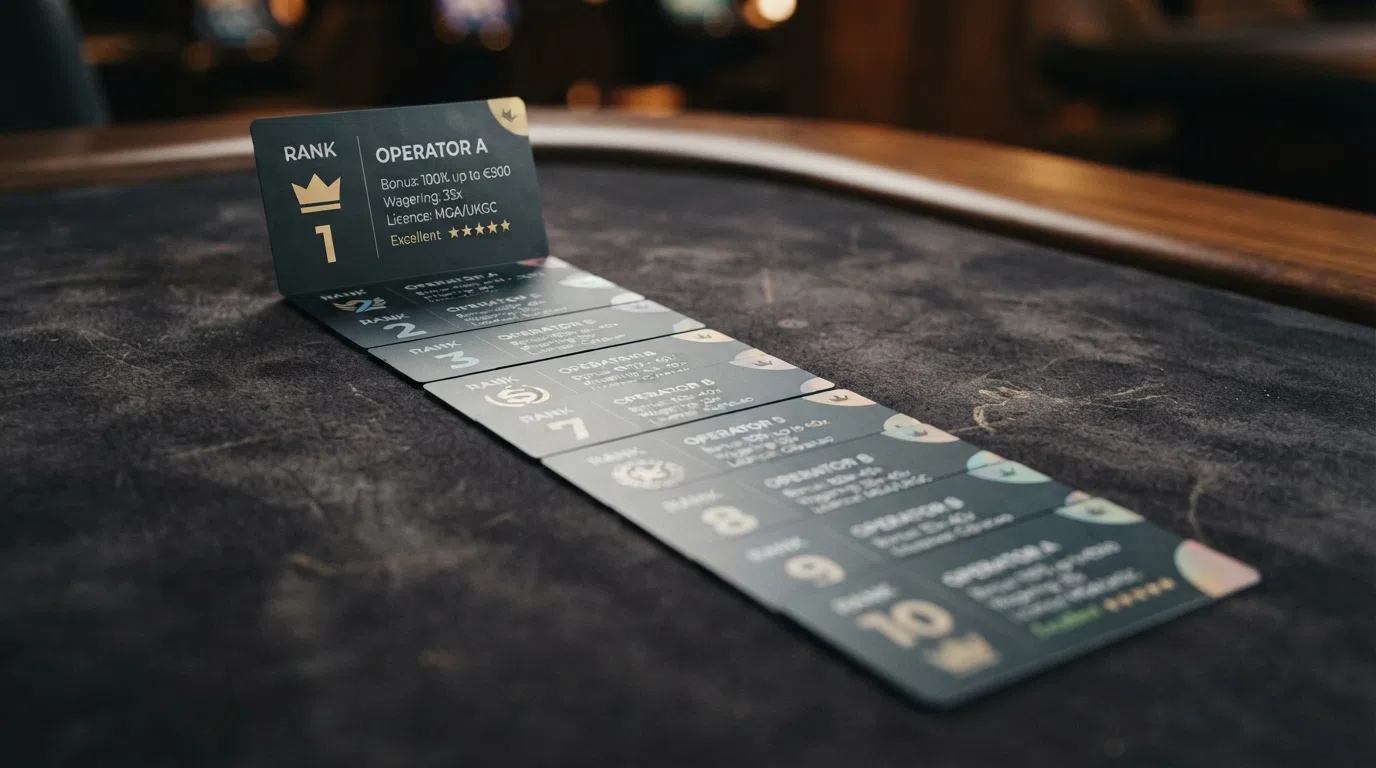
The featured set is ten operators that affiliate sources route into UK-facing search results. None holds a UKGC licence. All claim or are attributed an Anjouan licence; only one — Spinzen — publishes a licence number (ALSI-202409044-FI2) that can be cross-checked on the official register. The comparison below uses only what research confirms; where a term is not stated by the operator, the cell carries an em dash rather than an estimate.
| Operator | Anjouan licence status | Welcome bonus | Free spins | Wagering requirement | Bonus validity |
|---|---|---|---|---|---|
| Ybets | Claimed (no published number) | 500% up to $8,000 (4-tier) | 400 FS | 30x bonus / 45x FS winnings | 60 days |
| Megapari | Claimed | Up to €1,500 (4-stage) | 150 FS | 35x bonus | 7 days per stage |
| Boomerang Bet | Claimed (NovaForge) | 100% up to €500 / $750 | 200 FS (20/day × 10) | 40x deposit+bonus | 10 days |
| Spinzen | ALSI-202409044-FI2 (verified) | 270% up to €4,250 | 550 FS | 45x bonus | 5–7 days |
| Trickz | Claimed | 250% up to €2,000 (multi-tier) | 100 FS | 25x bonus | — |
| Winnerz | Claimed | 150% up to €1,000 (2-tier) | 100 FS | 25x–30x FS winnings | 3 days (FS) |
| OsomBet | Claimed | Multi-tier matched deposit | 200 FS | 35x bonus | 30 days |
| Let’s Jackpot | Claimed | 100% deposit bonus | 20 FS no-deposit | 35x | — |
| Del Oro | Claimed | Multiple bonuses (13-tier VIP) | — | — | — |
| FCMoon | Claimed | — | — | — | — |
All ten offers are denominated in euros or US dollars; none is denominated in pounds. The wagering figures vary by 2.5x from the lowest to the highest within the set, and the validity windows span from three days for free-spin wagering at Winnerz to sixty days for the headline bonus at Ybets. The em-dash cells in the lower rows are not gaps in the comparison — they are the comparison. Del Oro and FCMoon publish almost no bonus terms at all, which is itself information about what a player is signing up for.
Ybets
Ybets runs the largest headline package in the set — a four-deposit structure reaching 500% up to $8,000 plus 400 free spins on Gates of Olympus 1000. The bonus carries 30x wagering on the bonus funds and 45x on free-spin winnings, which is the dual-rate pattern that splits the workload across two separate playthrough obligations. The 60-day validity window is the longest in the set, which materially changes who this package suits: a player with the time and bankroll to grind through the turnover over two months will find the window generous; a player who can spare only a week will not.
The casino advertises more than 11,000 titles from a multi-provider aggregator setup, which puts it at the high end of the Anjouan market by catalogue size. Every figure on the bonus page is in US dollars; there is no GBP support, so UK deposits are converted at the cashier’s prevailing rate. The licence status is claimed rather than published — the site does not display a verifiable ALSI licence number — which means the responsible-gambler should check the operator’s entry on the official register before committing.
For a player who values catalogue depth over licence verifiability and who can pace themselves across a two-month window, Ybets is the headline package in the set. For anyone who treats a published licence number as non-negotiable, this is the wrong end of the table.
Megapari
Megapari’s welcome package is up to €1,500 plus 150 free spins across four deposit stages, with 35x wagering and a 7-day validity per stage. The 7-day window is the tightest in the set; a player who takes the full week to clear one stage and then starts the second will find the third stage’s clock already running. The library is large and multi-provider, with named bonus-linked titles including Luck of Panda: Bonus Combo and Power of Zorro.
The euro denomination is consistent across the offer, and the multi-stage structure means the player cannot simply deposit the maximum once and walk away. The arithmetic is unforgiving: clearing €1,500 at 35x requires €52,500 in turnover, and the 7-day window per stage imposes a pace that favours a high-volume player who treats the bonus as a structured project rather than a casual extra.
The licence status is claimed rather than published. For a player who values a multi-stage structure with named bonus titles and can sustain the required pace, Megapari’s package is workable. For anyone who reads a 7-day window as a constraint rather than a deadline, it is not.
Boomerang Bet
Boomerang Bet structures its welcome offer as a 100% match up to €500 or $750 plus 200 free spins released at 20 per day for ten days, with 40x wagering on the deposit-plus-bonus and a €20 minimum deposit. The 10-day bonus validity and the drip-fed free spins make this an offer that rewards steady daily engagement rather than a single long session.
The Anjouan licence attribution traces to NovaForge, an operator network that runs several casino brands from a common platform. That is a useful fact for verification: a reader who finds one NovaForge brand on the Anjouan register has reasonable grounds to expect the sister brands to be licensed under the same umbrella, though each brand’s individual status should still be checked. The 40x deposit-plus-bonus wagering is above the set’s centre of gravity and a step further from the UKGC 10x cap.
For a player who likes a structured daily routine and can pace themselves across a ten-day arc, Boomerang Bet’s offer fits. For a high-volume player who would rather deposit once and clear fast, the daily-drip free spins are a chore.
Spinzen
Spinzen is the only operator in the set that publishes a verifiable Anjouan licence number — ALSI-202409044-FI2 — and is therefore the easiest entry on this list to confirm against the official register. The welcome package is 270% up to €4,250 plus 550 free spins, the highest bonus cap and free-spin count in the set, with 45x wagering, a €5 maximum bet during wagering, and a 5-to-7-day validity.
The 5-to-7-day window is the tightest in the set, and the 10x deposit max-cashout cap from bonus winnings is the only such cap published in the featured group. That combination — a high headline figure, tight wagering windows and an explicit withdrawal ceiling — tells a player exactly what the offer costs in time and what the upside is capped at. The €4,250 bonus at 45x means €191,250 in required turnover; the 10x max cashout limits what the cleared bonus can ever pay out.
Spinzen is the operator a verification-first reader should anchor on. The published licence number does the work of trust signals that other brands leave the reader to infer.
Trickz
Trickz’s first-deposit bonus is 100% up to €500 plus 100 free spins at 25x wagering, with the full welcome package reaching 250% up to €2,000 plus 100 free spins across multiple deposits. The 25x bonus wagering is the lowest in the set and the closest to the UKGC 10x cap — still two-and-a-half times higher, but the smallest gap on the page.
The operator sits inside the Hitz Gaming OÜ network, another multi-brand platform arrangement. The minimum deposit is €20. The notable omission is a published bonus validity window; that gap is not a small one for a reader who needs to plan their clearing schedule. Before depositing, a player should ask the operator’s support team directly for the validity term and record the answer.
For a player who prizes the lowest wagering multiple in the Anjouan set and who is willing to chase down the missing validity term, Trickz is the most clearance-friendly headline. Other operators offer more transparency in their terms; a player who treats undocumented validity windows as a deal-breaker should look elsewhere.
Winnerz
Winnerz runs a 150% match up to €1,000 across two deposits plus 100 free spins on Gates of Olympus 1000, with 25x to 30x wagering on the free-spin winnings and a €20 minimum deposit. The standout term is the 3-day free-spin wagering window, the shortest in the set, which compresses the spin-winnings playthrough into a tight deadline. The library exceeds 3,500 games, which is mid-pack for the Anjouan cohort.
The dual wagering range on free-spin winnings — 25x to 30x — reflects a split between source attributions rather than a single number the operator has confirmed. A player who intends to maximise the free-spin element should clarify which multiple applies before depositing; a 5x difference in the wagering requirement is not a rounding error.
For a player who values a small, manageable package and is comfortable clearing free-spin winnings inside a single weekend, Winnerz fits. A player looking for a longer runway to meet the wagering obligations may find the 3-day FS window too restrictive.
OsomBet
OsomBet launched in 2023 as a crypto-and-fiat hybrid — one of the newer entrants in the Anjouan cohort and a useful illustration of the licence’s appeal to startups. The welcome package reaches 200 free spins across a multi-tier matched deposit, with 35x wagering and a 30-day validity, the second-longest window in the set after Ybets.
The dual-fiat-and-crypto cashier is the headline feature here. It extends the operator’s reach to crypto-native players who prefer not to route funds through a bank card, and it positions the casino alongside the Anjouan crypto-casino segment that has become a structural feature of the offshore market. The 30-day validity gives a measured player room to spread the turnover across a month rather than a week.
For a player who wants crypto acceptance and a month-long clearing runway, OsomBet is the natural fit in the set. However, those who view the anonymity of crypto deposits as a significant irreversibility risk should weigh that carefully before proceeding.
Let’s Jackpot
Let’s Jackpot’s distinguishing offer is the only no-deposit component in the featured set — 20 free spins credited without a deposit, sitting alongside a 100% deposit-match bonus. The wagering requirement is 35x, in line with the set’s centre of gravity. The free spins arrive without a deposit requirement, which lowers the barrier to seeing whether the casino’s product and cashier function as advertised before committing funds.
The gap is the same one Trickz carries: no published bonus validity window. A player who plans to clear the deposit bonus should obtain the term from the operator directly. The multi-provider catalogue is the structural backdrop; the no-deposit offer is the headline.
For a player who wants to test a casino’s product on the operator’s money before depositing, Let’s Jackpot’s structure is the only one in the set that allows it. The wagering requirement is not the lowest, but the entry cost is zero.
Del Oro
Del Oro advertises a thirteen-tier VIP bonus structure, the most complex loyalty model in the set, against a 3,500-plus game library. The 13-tier structure is presented as a feature; the honest reading is that almost none of its terms are published. There is no stated wagering multiple, no validity window, no free-spin count, no maximum cashout. The Anjouan licence is claimed rather than published, with no verifiable licence number on display.
The information gap here is not a missing row in a comparison table. It is the operator’s posture. A loyalty programme whose terms are opaque is a loyalty programme that can be reinterpreted at the operator’s discretion. A player who values clarity above headline complexity will read the absence of terms as the answer to the question, “should I deposit here?”
For a player who treats a 13-tier VIP programme as a reason to look closer, the closer look is not reassuring. Del Oro illustrates how thin the floor of the Anjouan market can be when an operator chooses to publish almost nothing about how its bonuses work.
FCMoon
FCMoon is the thinnest operator profile in the set. The only confirmed detail is a multi-provider setup. There is no published welcome bonus, no free-spin count, no wagering requirement, no validity window. The Anjouan licence is claimed but no verifiable number is on display. There is no GBP support and no GAMSTOP integration, as with the rest of the cohort.
The purpose of including FCMoon in this ranking is not to recommend it. It is to show what the floor of the Anjouan market looks like when an operator publishes almost nothing. The comparison table’s em-dash cells in this row are not clerical gaps; they are the operator’s own answer to what it offers. A reader who treats the absence of terms as a reason to ask questions will find there is almost nothing to ask about.
The fairest summary is that FCMoon illustrates why the verification step on the official register matters more for some entries on a list like this than others.
What Responsible Gambling Looks Like Without UKGC Oversight
The Self-Help Measures Anjouan Casinos Provide
The Anjouan licensing framework sets out responsible-gambling requirements — deposit limits, session limits, self-exclusion options — and most operators in the cohort implement some version of them. The structural gap is not the tools themselves but the absence of the mandatory deposit-limit prompt that UKGC licensees must surface before a customer’s first deposit from 31 October 2025. Anjouan casinos are not required to interrupt the deposit flow to ask the player to set a financial limit. The tools exist if the player seeks them out; the nudge does not.
Self-exclusion options at Anjouan casinos are operator-level only. A player who excludes themselves from one Anjouan-licensed casino can open an account at the next one the same afternoon. There is no multi-operator scheme, no shared database, and no equivalent to GAMSTOP. The KYC, AML and responsible-gambling rules exist in the framework, but enforcement is described as rare — the same tier-3 registration-style classification that applies to the licence as a whole applies to its safer-gambling obligations.
Where UK Self-Exclusion Hits a Wall — GAMSTOP and Offshore Sites
GAMSTOP is mandatory for every GB-licensed online operator since 31 March 2020. At the end of 2025 it carried 561,983 active self-exclusions, with 117,756 new registrations added during the year. That scale tells a story about how many British gamblers have decided they need a barrier between themselves and the next spin.
The barrier stops at the GB-licensed perimeter. A player who has registered with GAMSTOP and who then opens an account at an Anjouan-licensed casino faces no equivalent check, because the offshore operator is not part of the scheme and is not subject to the Commission’s LCCP. The same offshore market that hosts crypto casinos and headline bonuses also hosts every self-excluded British player who has not installed additional blocking software on their own devices. The protection gap is not theoretical, and the scale on the GAMSTOP side gives it weight.
UK Support Resources That Work Regardless of Casino Licence
The British support infrastructure operates independently of any casino’s regulator. The National Gambling Helpline — 0808 80 20 133, free, 24/7, run by GamCare — is reachable from any phone in the country and offers live chat as well as voice. The National Gambling Support Network treated 11,960 clients between April 2024 and March 2025, an 11% increase on the prior year, with over 52,000 calls handled and an average treatment wait of 1.3 days.
Beyond the helpline, the network includes NHS gambling harm clinics in England, Scotland and Wales; the TalkBanStop partnership offering free combined access to GamCare, Gamban blocking software and GAMSTOP; and Gamblers Anonymous peer support groups. GamCare’s 2024-25 reach runs to over 130,000 calls and online messages, 7,100 referrals into treatment, 8,100 treatment sessions delivered, and 64,000 people reached through education and prevention programmes. None of this depends on which casino the player last used or where it is licensed. The infrastructure is there; reaching it does not require the casino’s cooperation.
How We Evaluated and Ranked These Anjouan Casinos
The ranking draws on the official Anjouan Gaming register at Anjouan Gaming for licence verification, the Gambling Commission’s 2024-25 Annual Report for enforcement and regulatory context, the GAMSTOP 2025 Annual Report for self-exclusion scale, the GambleAware NGSN statistics for 2024-25 for treatment reach, and operator-facing licensing portals including anjouanlicense.io and Legarithm for fee structure and process. Affiliate review sites supplied the operator-level data on bonuses, wagering and free spins, with each operator’s own terms treated as the primary source for what the welcome package actually says.
All ten operators were confirmed as Anjouan-licensed or Anjouan-claiming casinos that accept UK players. The criteria applied qualitatively were licence verifiability — published licence number on the operator’s site, checkable on the register, versus a claimed status with no number — bonus transparency, meaning stated wagering, validity window and maximum cashout versus missing terms — and operator track record, including catalogue size, game-provider diversity and any published responsible-gambling infrastructure.
The limitations are stated plainly. Slot RTP figures for bonus-linked titles were not confirmed from a tabulating source this run. Individual operator licence numbers could not be independently verified against the official register for all ten via available search means, which is why Spinzen’s verified ALSI-202409044-FI2 is highlighted as the exception rather than the norm. All bonus figures are the operator’s own, as reported by affiliate sources, and have not been re-keyed against the live bonus pages. A reader who intends to deposit should re-check the terms on the operator’s own site, because bonuses and wagering terms change.
Should You Play at an Anjouan-Licensed Casino from the UK?
The honest summary is that an Anjouan licence is a real operating permit — cheaper and faster to obtain than a UKGC licence and capable of supporting a multi-provider casino with a large game catalogue — but it was not designed for UK player protection and does not provide it. The operator accepting British customers is committing an offence under section 33 of the Gambling Act 2005 while also breaching its own Anjouan licence terms, which list the UK as a restricted territory. The player commits no established criminal offence but gambles without any of the GB regulatory safety net.
The concrete losses are: no independent ADR if a withdrawal is declined, no segregated player funds if the operator fails, no GAMSTOP if self-exclusion is the chosen safeguard, no £5/£2 stake cap, no 10x wagering ceiling, no credit-card block, and no British consumer redress route. The bonus economics amplify the asymmetry — headline figures at Anjouan casinos run 2.5x to 4.5x the UKGC 10x cap, and the validity windows are tight enough that clearing the bonus inside them is a material project rather than a casual extra. The “free” component of the most aggressive package in the featured set implies over 265 hours of continuous play and an expected house-edge loss that exceeds the bonus amount.
A player who, with those facts in view, decides to proceed should treat the verification step as non-negotiable: cross-check the operator’s licence number on the official Anjouan register before depositing, read the full bonus terms for the validity window and any maximum-cashout cap, set a personal deposit limit before the first deposit rather than after, and keep the National Gambling Helpline number — 0808 80 20 133 — somewhere they can find it without searching. The decision is the player’s, and the British support infrastructure does not depend on which casino they chose.
Frequently Asked Questions About Anjouan Casino Licensing
What happens if an Anjouan casino refuses to pay out — is there a dispute resolution body?
No. Anjouan-licensed casinos do not sit within any independent ADR scheme, so there is no eCOGRA, IBAS or MGA Player Support Unit equivalent to escalate a declined withdrawal or a voided bonus. The player must negotiate directly with the casino, and if that fails, the only practical remedies are the operator’s own internal escalation and a chargeback through the card issuer (which is unavailable for crypto deposits). The absence of an ADR pathway is one of the principal protection gaps discussed earlier in this guide.
Can I use a credit card to deposit at an Anjouan casino?
Yes. The UK credit-card ban on gambling applies to GB-licensed operators under LCCP licence condition 6.1.2 from 14 April 2020; it does not extend to Anjouan-licensed sites, which are outside the UKGC’s regulatory reach. UK card issuers may still block gambling transactions under their own policies, but the Anjouan operator is under no obligation to refuse credit-card deposits. The credit-card ban is one of several product-safety rules in the GB market that do not apply offshore, as the comparison table earlier in this guide sets out.
Are winnings from Anjouan casinos taxable in the UK?
No. Gambling winnings are not taxable for UK players regardless of where the casino is licensed, which means a withdrawal from an Anjouan-licensed casino is treated the same as a withdrawal from a UKGC-licensed one for personal tax purposes. The tax sits with the operator: UKGC licensees pay 40% Remote Gaming Duty from 1 April 2026 and a 1.1% statutory levy on gross gambling yield from 6 April 2025. Anjouan-licensed operators do not carry those costs, which is part of the reason their bonus caps are larger.
How much does an Anjouan gaming licence cost an operator?
Approximately €17,000 per year in total. The breakdown is roughly €13,300 for the annual regulator fee, around €2,000 per Key Person, and €1,700 for ISP monitoring and compliance. Processing takes two to four weeks and the licence renews annually. That figure is materially lower than the effective cost of a UKGC remote casino licence once Remote Gaming Duty and the statutory levy are added, which is the structural reason Anjouan licensing appeals to startup operators and to brands whose business model depends on aggressive bonus economics.
Does GAMSTOP cover Anjouan-licensed casinos?
No. GAMSTOP is mandatory for every GB-licensed online operator since 31 March 2020, and at the end of 2025 it held 561,983 active self-exclusions with 117,756 new registrations during the year. Anjouan-licensed casinos are outside that scheme because they do not hold a UKGC licence and are not subject to the Commission’s LCCP, so a player who has self-excluded through GAMSTOP can still open an account and deposit at an Anjouan-licensed casino. The offshore gap is one of the more serious practical consequences of the protection framework discussed earlier in this guide.
What are the main risks of playing at an offshore Anjouan casino from the UK?
The principal risks are the absence of an independent ADR pathway if a dispute arises, no mandated segregation of player funds, no GAMSTOP coverage, no UKGC complaints route, no British consumer redress, and the fact that the operator is simultaneously breaching British law under section 33 of the Gambling Act 2005 and breaching its own Anjouan licence terms by serving UK customers at all. Product-safety rules that apply under a UKGC licence — the £5/£2 stake cap, the 10x wagering ceiling, the credit-card ban, auto-play restrictions, the 2.5-second spin minimum and the reverse-withdrawal ban — do not apply offshore, and bonus terms in the Anjouan cohort are typically tighter on validity windows and lighter on player protections than their UK-licensed equivalents.
Licence – Casinos That Accept Bitcoin UK
Content created by the «Casinos That Accept Bitcoin UK» team